Warm mix asphalt
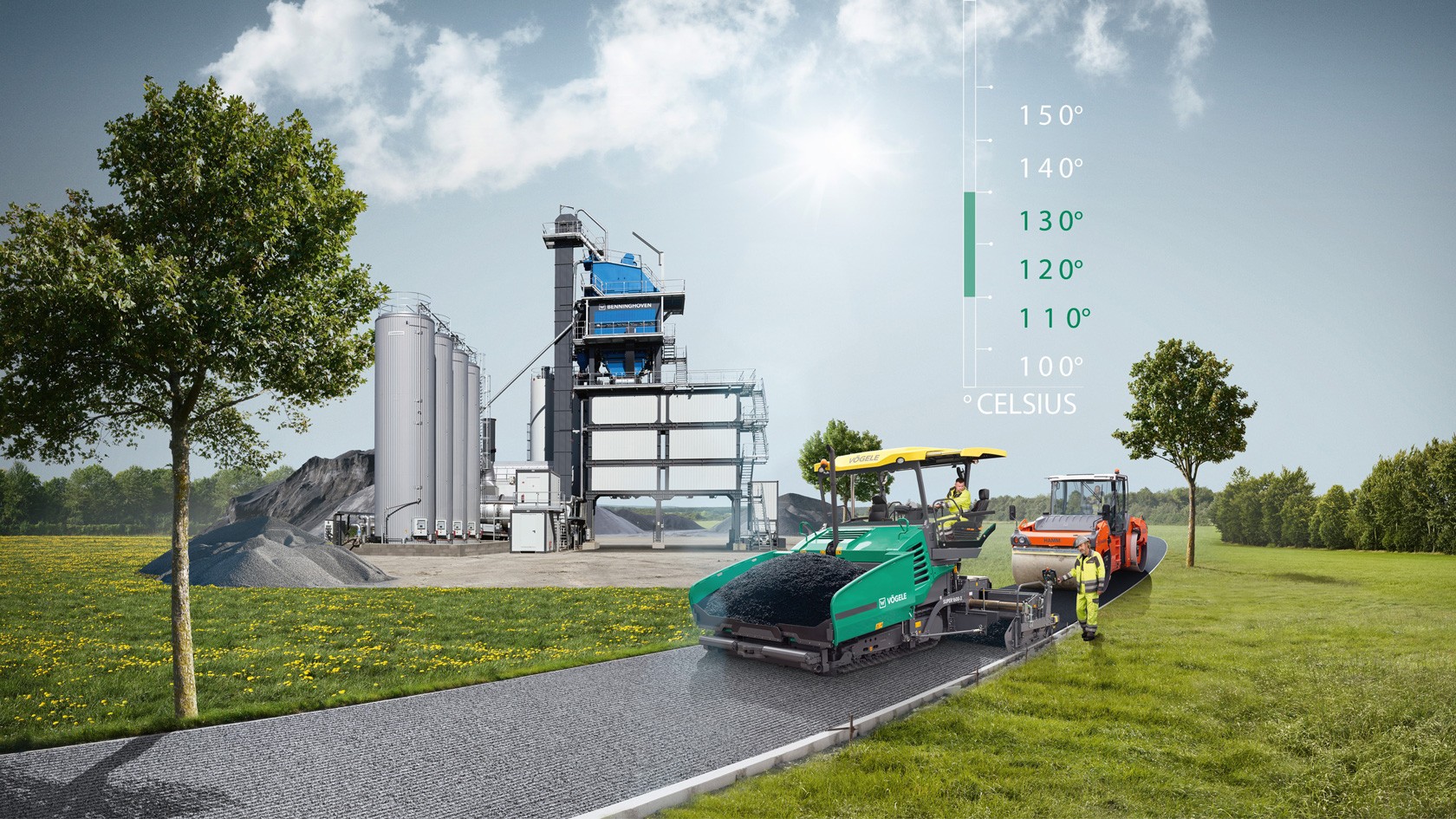
The potential for saving energy is one of the most important drivers of this trend: warm mix asphalt (WMA) as a road construction material is currently becoming more and more important. Technologies and solutions from the Wirtgen Group are the perfect response to this trend – and play an important role in ensuring that the production and utilisation of lower-temperature mixes is achieveable with conventional methods and equipment.
Warm mix asphalts (WMA) – also known as warm asphalt, warm mix, low-temperature asphalt, or reduced temperature asphalt – are mixes produced at temperatures of 110°C to 130°C. In contrast, conventional hot mix asphalts (HMA) are produced at 140°C to 180°C – typically with hot bitumen at a temperature of 160°C as a binding agent. There are various reasons for the growing trend toward the use of this construction material in many countries and regions.
The production and use of warm mix asphalt brings a number of financial benefits. Die Gesamtenergiebilanz dieser Mischgüter fällt wesentlich günstiger aus. Lower energy consumption always means fewer emissions, in particular, a considerable reduction of CO₂ emissions. Increased environmental friendliness is an important issue, which explains why warm mix asphalt ranks high on the agenda of authorities around the globe. According to the German Asphalt Association, a temperature reduction of just 30°C results in savings of 0.9 litres of heating oil (or a fuel equivalent) per tonne of finished asphalt. At a daily production rate of 2,000 t of mix, this corresponds to a saving of 1,800 litres of oil – or up to three-quarters of the annual heating energy consumed in a domestic household. The reduction in CO₂ emissions amounts to 6,000 kg per day. The figures that can be realised in the real world are significantly higher – primarily because the reduction in temperature often amounts to 50°C or more.
Foamed bitumen is the binding agent of choice when it comes to the production of warm mix asphalt. Benninghoven is an absolute specialist in this field and can also integrate the required technology into existing plants.
M.Sc. Ertugrul Aksakal, Development Engineer Research and Process Technology at BENNINGHOVEN
The Wirtgen Group product brands are already paying their way in the production of warm mix asphalts. Particularly in the case of Benninghoven. After all, the main contribution to energy saving and the reduction of emissions lies in the production process, i.e. in one of the Benninghoven asphalt mixing plants. In this context, the specialist for the production and recycling of asphalt mixes of all kinds can draw on decades of experience and expertise – especially when it comes to the use of environmentally-friendly technologies.
The reduction of bitumen viscosity is a basic requirement for the production of asphalt at lower temperatures. This is because the bitumen used as a binding agent requires a temperature of at least 140°C to coat the aggregate and remains too viscous at temperatures below this value. In view of this, Benninghoven has developed and successfully implemented a variety of solutions for temporarily reducing the viscosity of the bitumen binder. Amongst these are high-precision dosing systems for the addition of liquid or solid additives and the Benninghoven foamed bitumen module.
Foamed bitumen is particularly attractive as a binding agent for the production of reduced-temperature asphalt because it only requires water as an additive, which is available at every asphalt mixing plant anyway. Mixing hot bitumen with water increases its volume many times over – this is also known as bitumen foaming. Due to the surface energy released, the binding agent coats the aggregate extremely well during the mixing process – even at low temperatures – and results in smooth paving properties.
The technology behind the foamed bitumen module offers a key benefit for asphalt mixing plant operators. This plant option only needs to be installed as an extension to the weighing and mixing section. It consists of a bitumen pump, an expansion chamber, pipework, injection bars and a water dosing system. Thanks to the Benninghoven ‘plug & work’ concept, the foamed bitumen module can also be retrofitted to existing plants at any time by removing the blind cover from the mixing chamber and the bitumen weighing hopper and installing the foamed bitumen module – it’s as simple as that! In conjunction with Benninghoven’s gentle and high-quality material handling, this enables the production of warm mix asphalts that can easily compete with conventional asphalt mixes.
The desired temperature reduction during asphalt production is achieved by temporarily reducing the viscosity of the bitumen with water or additives. On the one hand, low bitumen viscosity can be achieved with foamed bitumen technology or with additives.
Learn moreWhat field-proven solutions does Vögele offer for paving with warm mix asphalts?
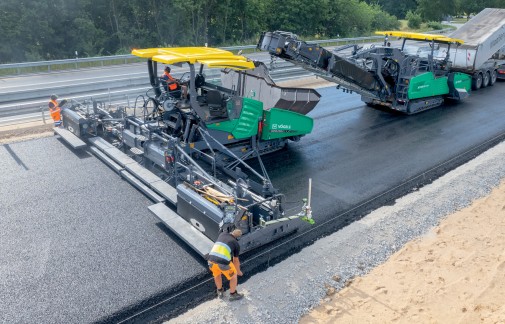
The next step after transporting the asphalt mix to the construction site is transferring it to the road paver. This is carried out by a Vögele MT 3000 series mobile feeder: They support the transfer of the mix from a truck to the paver to ensure a constant, uninterrupted, and efficient paving process.
Thanks to their highly-efficient conveyor concept, mobile feeders can offload 25 t of mix in 60 seconds. A trough-shaped conveyor belt ensures steady material conveying, and the effective belt heating system reliably keeps the mix at the ideal temperature, preventing mechanical and thermal segregation. All these functions enable fast and homogeneous transfer of the warm mix asphalt to the Vögele road paver – with almost no appreciable temperature loss.
Vögele machines are ideal for paving warm mix asphalts – from the material conveying concepts of the mobile feeders and road pavers and the high-compaction technology of the paving screeds to WPT Paving digital construction site documentation with the RoadScan temperature measuring system.
Bastian Fleischer, Product Manager at VÖGELE
Extra material hopper, heated auger plough, and high-compaction technology
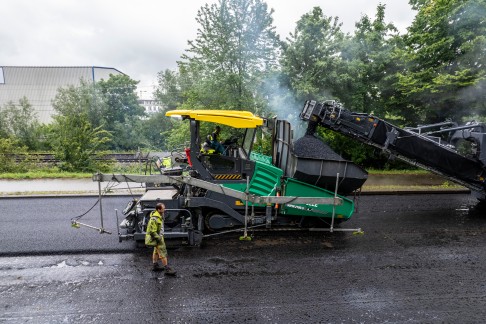
When using a mobile feeder, the road paver is fitted with an extra material hopper, The system can then take up to 45 t of mix on board. This is a prerequisite for achieving non-stop paving.
The mix is continuously transferred from the extra material hopper to the spreading augers via the ascending conveyors. The auger plough located in front of the centre bearing pedestal evenly distributes the mix to both sides. This is electrically heated to effectively prevent the adhesion of mix and ensure perfect placement of the mix in front of the paving screed.
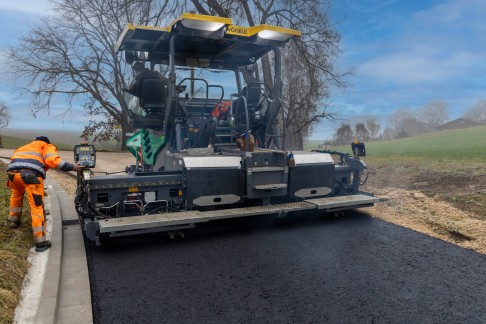
In the next step, Vögele paving screeds enable true to line and level paving of the warm mix asphalt. The use of a high-compaction screed is recommended for paving this type of mix. It achieves such good pre-compaction values that the number of compactor passes required for final compaction is considerably reduced.
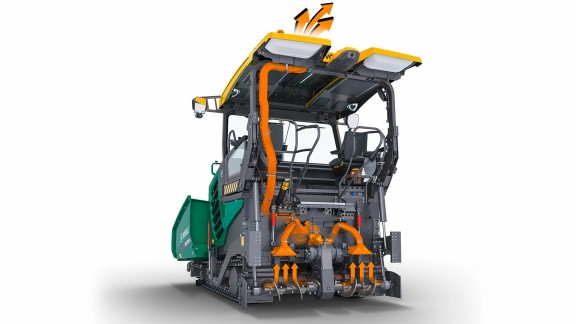
The ventilation system from Vögele provides additional protection for the paving crew by reliable suction extraction of harmful vapours and aerosols from the auger tunnel.
The perfect interaction of all machines involved in the process chain is particularly important when paving warm mix asphalts. The holistic consideration of an entire construction project offers the greatest potential for improving productivity and quality. By networking all machines, systems, and processes involved in the construction process, digitalisation is in a position to exploit the entire spectrum of available potentials.
WPT Paving: digital paving and construction site documentation from Vögele
With the Wirtgen Group Performance Tracker for road construction (WPT Paving), operators can continuously track the construction progress of their Vögele paver and document the most important paving parameters. The RoadScan temperature measuring system seamlessly measures the temperature of the paved asphalt behind the screed. These performance data are then made available for further analysis in the John Deere Operations Center™ Construction.
Analyses indicate possible potentials for improvements and enable continuous optimisation of the entire paving process chain. By the way, the data can also be used as proof of performance for clients and regulatory authorities.
With WPT Paving Pro and the RoadScan temperature measuring system from Vögele, relevant paving and temperature data are automatically transferred to the John Deere Operations Center™, where they are then available for documentation purposes and analyses.
Learn moreThe most effective method for compacting warm mix asphalts is the long-established oscillation method. Permanent contact of the oscillation drum with the paved surface enables a rapid increase in compaction. As well as being gentler on materials than the vibration method, oscillation ensures that surface damage is avoided when compacting at lower asphalt temperatures. The advantages of oscillation also play an important role when compacting joints and prevent damage to the already cooled asphalt. All in all, using oscillation expands the time window available for compaction before the stiffness of the mix dramatically increases and the asphalt becomes difficult to work with.
A further solution for the achievement of a high degree of process reliability is the Smart Compact Basic compaction assistant, which continuously regulates the compaction energy and modes in both drums of HX series tandem rollers under consideration of the cooling behaviour of the asphalt and the momentary stiffness values. In Smart Compact Pro, real-time density replaces the stiffness value as the key parameter and decisive factor for qualitative assessment during the compaction process. Smart Compact then decides on the operator’s behalf whether compaction should be carried out statically, with vibration or with oscillation and selects the required compaction energy. This effectively prevents over-compaction, minimises surface damage and reduces the number of double passes. As such, Smart Compact increases the efficiency of compaction and makes optimum use of the time available, which represents major added value in connection with warm mix asphalts.
The optimal use of the available time window is also promoted by a high degree of transparency in all aspects of the compaction process. With Track Assist, Hamm offers a further digital solution that provides operators with real-time density information, the number of passes, asphalt temperatures, temperature limits and other compaction parameters. The constant and full transparency of the compaction process makes it easier for operators to compact warm mix asphalts. The number of unnecessary double passes is also reduced, which means that the operator can make ideal use of the time window available for compaction. The Track Assist app can be downloaded free of charge from the Google Play Store.