Pioneer in Scandinavia

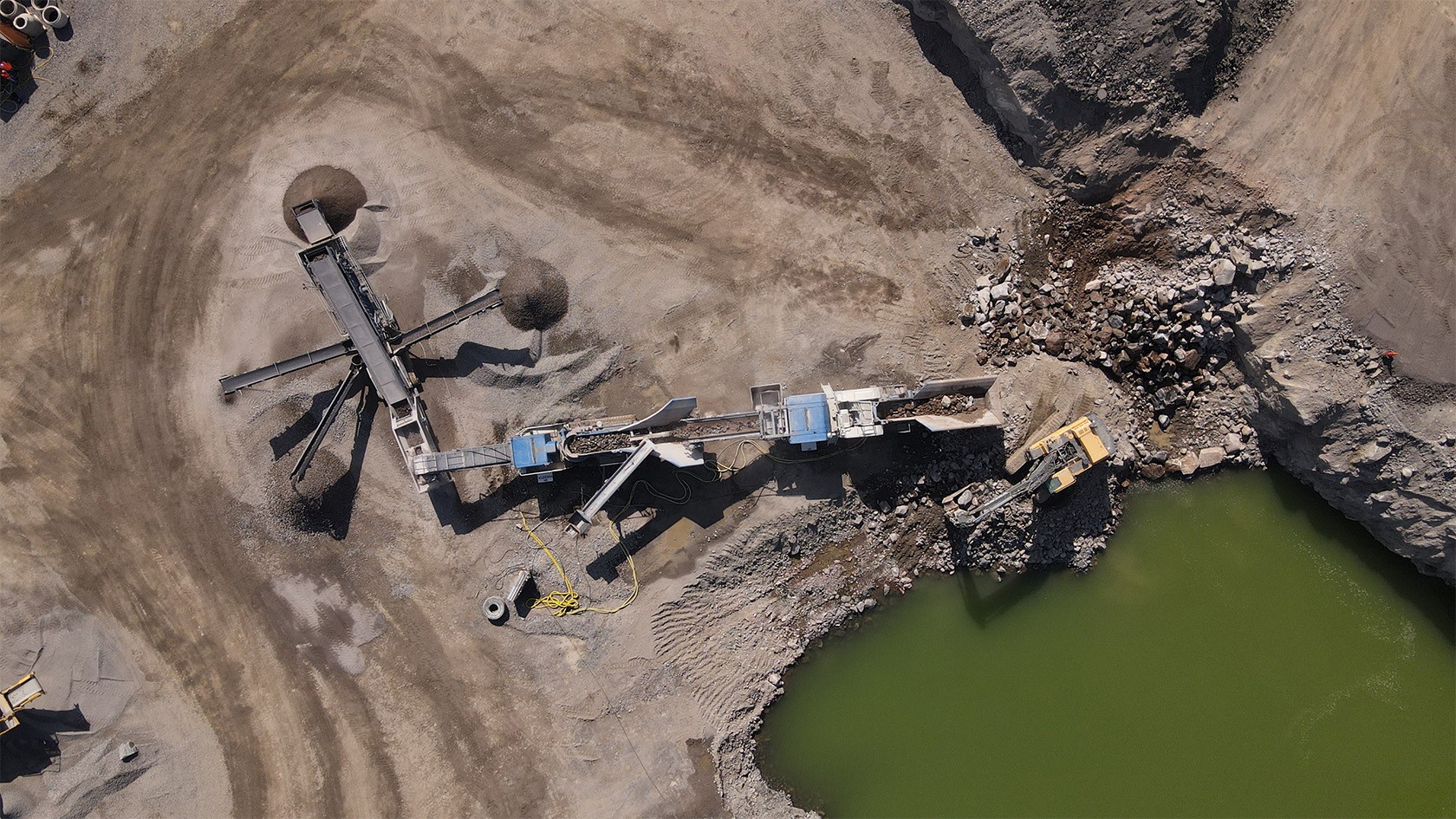
A bird’s eye view of the plant train in a quarry. In the foreground, a bright green quarry pool.

Resource-efficient and forward-looking

An all-electric Kleemann plant train in Sweden

In the coastal region of Stockholm, the company Kentas Last & Schakt AB is taking a remarkable step into the future: The complete crushing and screening process is carried out there all-electrically – with a linked plant train from Kleemann, consisting of the jaw crusher MOBICAT MC 120 PRO, the cone crusher MOBICONE MCO 110 PRO and the screening plant MOBISCREEN MSC 953 EVO. The company thus becomes one of the pioneers in this sector in Scandinavia.

The range of applications is challenging: Kentas Last & Schakt AB predominantly processes granite and RAP material. The feed material therefore varies greatly, which means that the machine settings have to be frequently adjusted. The company decided on a plant train consisting of three Kleemann machines: From the jaw crusher, the crushed material with a grain size of 0–150 mm reaches the cone crusher, then, with a size of 0–60 mm, it reaches the mobile classifying screen where it is separated into three grain sizes: 0–16 mm, 16–32 mm and >32 mm.

The material flow: The jaw crusher pre-crushes the material, the cone crusher shapes it, the screening plant classifies it into two final products and removes oversize grain.

All-electric – out of conviction

However, there is one difference compared to (previous) traditional plant trains: The complete train operates only on electricity. “Our decision to go fully electric was motivated by energy-saving considerations and the desire to reduce emissions," explains co-owner Freddie Erickson.

Portrait of Freddie Erickson, co-owner of Kentas Last & Schakt AB

“The operating costs for an electric power supply are about half those for diesel.”

Freddie Erickson, co-owner of Kentas Last & Schakt AB, is convinced that switching to all-electric operation was a wise decision –and the reduced exhaust emissions on the site prove him right – both for the environment and for the overall efficiency of his company.

The investment also pays off in terms of efficiency: “The operating costs for an electric power supply are about half those for diesel,” says the entrepreneur happily. The processes have also been simplified: No daily refueling, no warm-up time, and even maintenance has become easier; the electrical systems have proven to be more reliable.

Of course, the changeover did not come without financial and logistical costs:Kentas Last & Schakt AB invested a high 6-figure euro sum in infrastructure measures, including a transformer station and underground cables. There was no state funding. But the location conditions were so good that the project could be mastered.

Initially, investment in the transformer station and the cables was necessary. But when the infrastructure was in place, the advantages outweighed the disadvantages.

Positive resonance:

The feedback from the workforce is clear: faster plant start-up, lower noise emissions, no on-site operational emissions and easier handling.

In-house...

‘The employees appreciate the altogether and less complex operations,’ reports the operator of the plant train. This is because the machines do not require any warm-up time, maintenance costs are significantly reduced and the machines do not need to be refueled daily. Erickson estimates that the operating costs are around 50% lower than with diesel.

... and OOH

The electrified plant train is also appreciated by customers – particularly by public sector clients, who are increasingly opting to eliminate diesel engines from on-site operations, but also by other customers who are seeking such technologies. ‘Nowadays some customers explicitly demand the use of electric machines.’

Robust technology for demanding materials

The processes of the plant train are also state-of-the-art. Automatic line linking guarantees a trouble-free work process: The machines communicate via fill level sensors and regulate their output: The upstream machine, for example, reduces the feed when the downstream machine reports a high fill level. This ensures that production runs smoothly and efficiently, with maximum safety. If an emergency stop is activated anywhere on the train, all machines stop simultaneously.

SPECTIVE CONNECT is used for operation on site. This allows machine data and settings to be conveniently viewed and adjusted via smartphone – safely and efficiently, without having to be directly at the plant.

The Kleemann plant train in operation: Thanks to intelligent line linking, production runs smoothly and without downtimes.

Conclusion: Change continues to be driven forward

The experience with all-electric operation has been entirely positive. Although implementation initially involved costs and time, the advantages outweigh these factors: Lower operating costs, easier maintenance, and greater efficiency. Due to the positive results, Kentas Last & Schakt AB is already planning to electrify additional machines. “We are actively working to convert as many machines as possible to electric power. This is clearly the way forward, and we are determined to implement this change across our entire fleet.”

Erickson, father and son, operators of Kentas Last & Schakt AB, standing in front of the plant train.

“We are actively working to convert as many machines as possible to electric power. This is clearly the way forward.”

Erickson, father and son, operators of Kentas Last & Schakt AB

Facts and figures
Plant train
Cone crusher:
MCO 110 PRO
Jaw crusher:
MC 120 PRO
Screening plant:
MSC 953 EVO
Final products (from the screening plant)
Fine grain:
0-16 mm
Medium grain:
16-32 mm
Oversize grain:
<32 mm
Material
Feed material:
Granite, recycling material
Piece sizes of recycled material:
0-600 mm


Details and further information can be found on our product pages.

Media & press

Click here to download a ZIP file containing the press release in the available languages in Microsoft Word format and the images in 300 dpi resolution.

Download