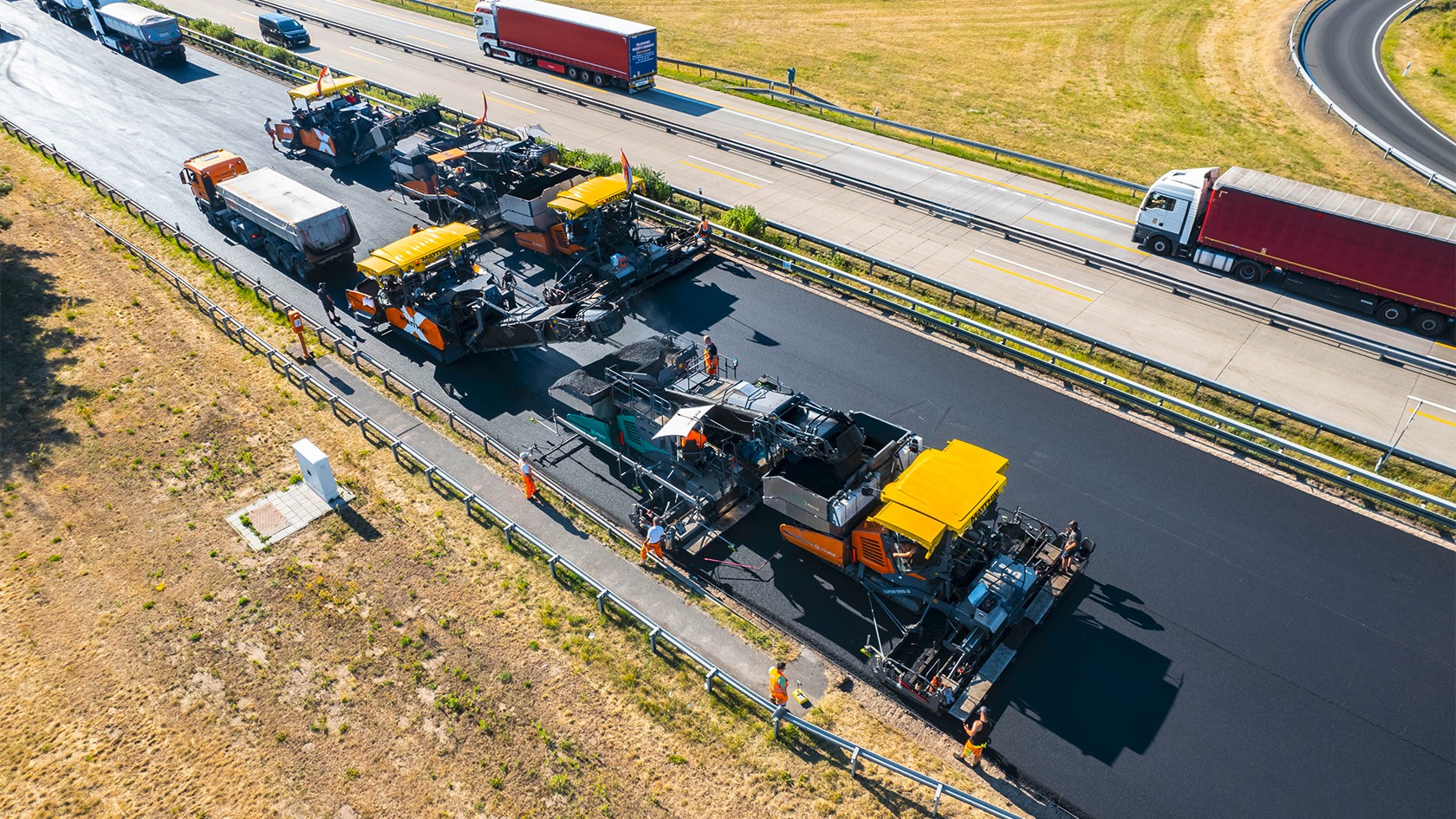
Two InLine Pave paving trains from Vögele pave ‘hot on hot’ and ‘hot to hot’

Faster, better and more resource-efficient paving

Highway rehabilitation by Vögele‘s InLine Pave method

A section of the southern part of Berlin’s orbital road needed renewing as a result of severe rut formation. In order to rehabilitate this section of the busy urban motorway to a high standard as quickly as possible while conserving resources, the contractor decided to use two InLine Pave paving trains from Vögele. They paved the surface and binder courses ‘hot on hot’ and ‘hot to hot’, Not only increasing the quality and resistance to deformation of the carriageway, but also saving time, money and resources.

Germany | Berlin

At the Ludwigsfelde-West intersection, the A10 motorway, which belongs to the southern part of Berlin’s orbital road, is subjected to extreme loads due to heavy traffic. As the pavement had become significantly rutted, the surface and binder courses needed renewing over a length of 4.2 km and a width of approximately 15 meters. This placed extreme demands on the paving process: to stop the ruts forming again, the new roadway had to be paved to high standards of quality, load-bearing capacity and durability. Other requirements were the conservation of resources and reopening the stretch of highway to traffic again as quickly as possible.

Photo, right: Two InLine-Pave paving trains from Vögele were used on the A10 simultaneously.

Tolles Produkt

Two layers in one pass

Consequently, the lead contractor – a consortium comprising Matthäi Michendorf and Matthäi Stendal – decided to pave ‘hot on hot’ with two InLine-Pave paving trains from Vögele. This method requires the material feeder, the paver for the binder course and the paver for the surface course to work ‘in line’ to pave the surface and binder courses in one pass. This method offers a number of advantages: “Hot on hot” paving of the binder and surface courses guarantees optimum bonding between the two, improving the quality and service life of the surface course. The proportion of surface course relative to binder course can be reduced. That improves the stability of the pavement thanks to the higher proportion of stable binder course and prevents deformation. On the other hand, the approach reduces the costs, because less binder-rich surface course mix - which is much more expensive than binder course mix - is required. In contrast to conventional paving, there is also no need to spray on bitumen emulsion, which saves mix material and working time. ‘The InLine-Pave method is ideal for motorway projects in particular, and generally for those projects requiring an especially resilient surface to be paved under significant time and cost pressures,’ says Frank Jilge, paving supervisor at Matthäi.

The InLine-Pave method: the advantages at a glance:

Quality

  • ‘Hot on hot’ paving for optimal bonding between layers
  • Higher proportion of stiffer binder course delivers high resistance to deformation
  • High-compaction technology for maximum evenness


Resourc-efficiency

  • Eliminating the need for a bitumen emulsion tack coat means less material required
  • Up to 13% lower operational CO₂ emissions compared to conventional paving methods through potential reduction of mix usage, transport movements, machine hours, and additional work steps (project-dependent)
  • A higher proportion of binder course with good resistance to deformation increases the stability of the pavement.


Efficiency

  • Paving the surface and binder courses in one pass saves time
  • Eliminating the need for a bitumen emulsion tack coat reduces working time
  • Use of expensive, binder-rich surface course material is reduced in favour of low-cost, stiffer binder mix
  • Higher utilisation rates through the use of standard production machines

Read more about the InLine Pave method

Two pave trains for maximum efficiency

The time window for rehabilitating this section of highway was extremely tight. the entire section had to be renewed and then reopened to traffic in just two days. In view of this, the paving team deployed two InLine Pave trains, each made up of three machines: In each train, a high-performance MT 3000-3i Offset material feeder took up the mix material for the binder and surface courses and conveyed it directly to the material hopper or the transfer module of the following SUPER 2100-3i IP paver at precisely timed intervals. The modified Highway Class pavers created a 6 cm thick binder course, and conveyed the surface course material via the transfer module to the following SUPER 1900-3i, which then directly laid down the 2 cm thick surface course. In order to meet the tight time constraints, the two paving trains worked in parallel on two lanes, each 7.5 m wide. ‘The combination of 'hot on hot’ and ‘hot to hot’ really helped us get the maximum efficiency out of the machines,’ says Jilge.

Frank Jilge (right), Matthäi paving supervisor

‘The InLine-Pave method is ideal for motorway projects in particular, and generally for those projects requiring an especially resilient pavement to be paved under significant time and cost pressures.’

Frank Jilge (right), Matthäi paving supervisor, with application consultant André Felchner from Vögele.

High compaction guarantees quality and durability

The InLine Pave method was also a good choice in terms of quality requirements. Both the thinner surface course and the high degree of precompaction contributed to the high quality and stability of the new roadway. The core of the pave train, the SUPER 2100-3i IP paver for the binder course, was equipped with an AB 600 TP2 Plus extending screed. With a tamper bar and two pulsed-flow hydraulic pressure bars, the extending screed achieves maximum compaction values of up to 98%. This allowed the paving team to compact the binder course so that it was highly resistant to deformation, allowing the surface course pavers which followed to work on the layer beneath immediately, while it was still hot. The high degree of precompaction meant that only a few passes of the roller were subsequently required, again saving working time.

Pulsed-flow hydraulic pressure bars are at the heart of high-compaction technology

High-compaction technology from Vögele

The pulsed-flow hydraulic pressure bars are at the heart of Vögele high-compaction technology. In combination with TP1, TP2 and TP2 Plus screeds, the Vögele pavers achieved maximum compaction values of up to 98% – without the need for rolling.

Read more about high-compaction technology

Focus on resource-efficiency

The aims of both the client and the contractor during the rehabilitation of the Berlin orbital were to utilise the machines and material as efficiently as possible and conserve valuable resources. InLine-Pave was also a convincing method in this respect: ‘Hot on hot’ paving meant that there was no need for the bitumen emulsion tack coat used in conventional paving, Saving material, costs and the CO₂ emissions which arise during production and paving - as well as additional working time. Add to this the fact that Matthäi also uses all the machines in the IP train as standard machines - so is able to utilise them to the full. The only modification required before use on conventional paving projects is the removal of the binder course paver’s transfer module.

‘The combination of 'hot on hot’ and ‘hot to hot’ really helped us get the maximum efficiency out of the machines.’

Frank Jilge, Matthäi paving supervisor

An MT 3000-3i Offset Offset high-performance material feeder took on the mix for the binder and surface courses on delivery and alternately conveyed it straight to the material hopper or transfer module of the respective SUPER 2100-3i IP following on.

Tried and tested method

The project on the Berlin orbital road was a success: Matthäi completed the job on schedule, in two days. ‘While every job site presents fresh challenges, at least the paving method was a tried and tested one for us,’ says Jilge. ‘We have been deploying InLine Pave technology from Vögele since 2004, because it delivers so many benefits. Large-scale and highway job sites are routine for us, so reliable machine technology and on-site application consulting are key to our success.’

‘We have been deploying InLine Pave technology since 2004, because it delivers so many benefits.’

Frank Jilge, Matthäi paving supervisor

Facts and figures about the job site
Paving parameters
Length
4.2 km
Paving width
15 m
Paving speed
3.5 m/min
Binder course layer thickness:
6 cm
Thickness of paved surface layer:
2 cm
Machines deployed
MT 3000-3i Offset
2x
SUPER 2100-3i IP
2x
SUPER 1900-3i
2 x


Media & Press

Click here to download a ZIP file containing the press release in the available languages in Microsoft Word format and the images in 300 dpi resolution.

Download

Please visit our product pages for details and further information.