

Project location
- Region:
- São Paulo / Guará region (Brazil)
- Location:
- São Joaquim da Barra
- Company:
- Usina Alta Mogiana
September 2026 | Reading time: 9 min
Brazilian sugar cane producer relies on a Vögele paver
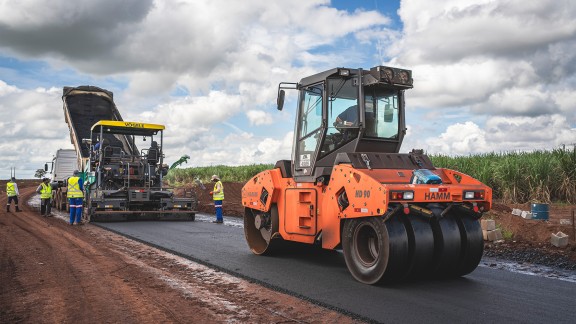
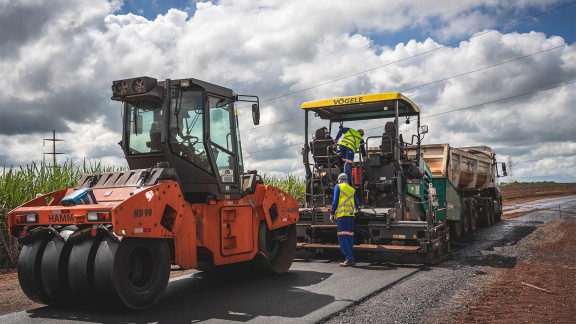
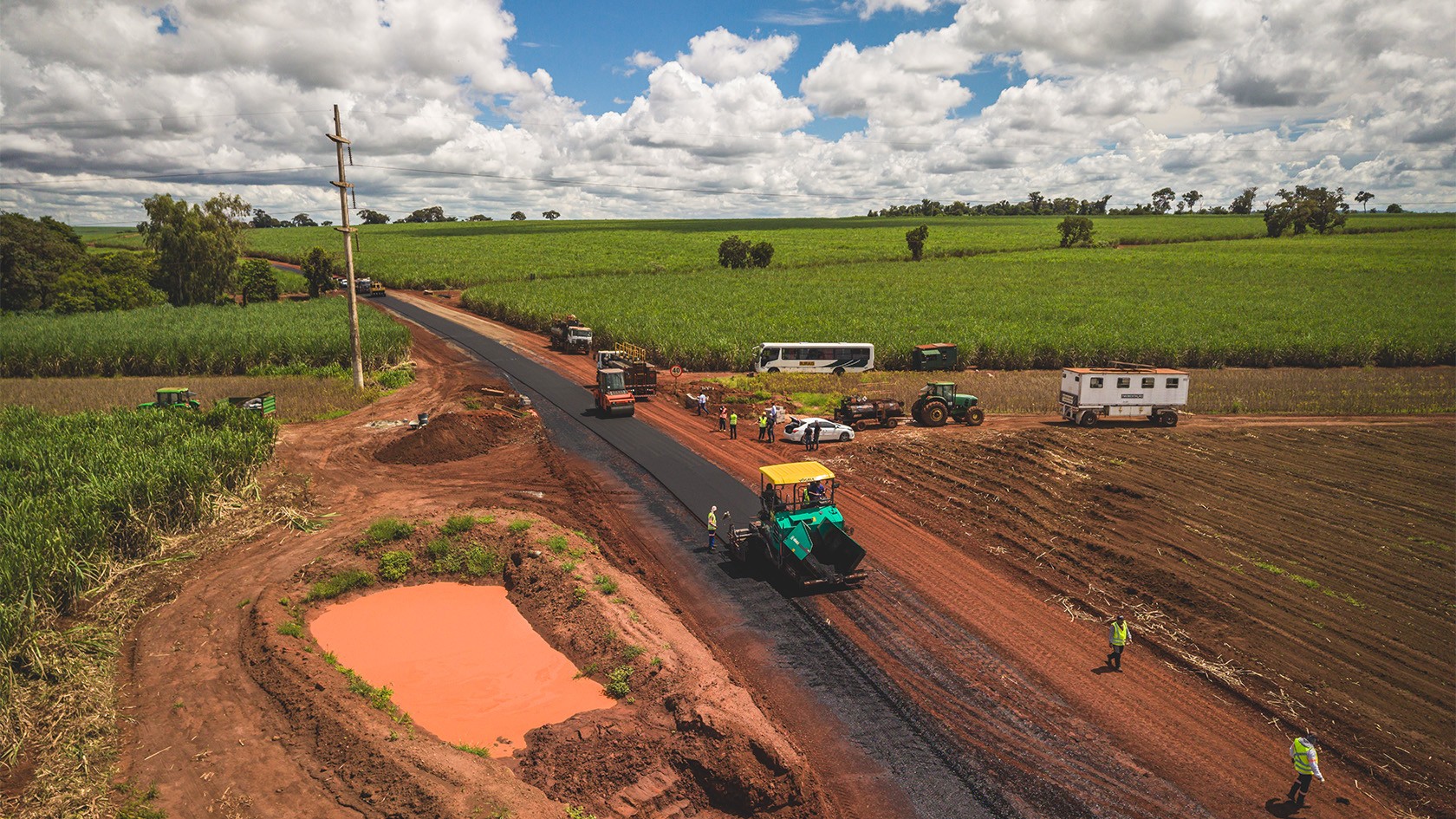
In order to increase productivity, a Brazilian company decided to pave the around 60 km internal network of roads through its plantations – and demonstrated a real DIY approach to it: instead of commissioning a road construction contractor to carry out the project, the company went ahead and invested in a Vögele paver and a Hamm roller and had its own workers trained in the skills of asphalt paving. The results are impressive, and have the potential to reduce transport logistics costs by 25%.
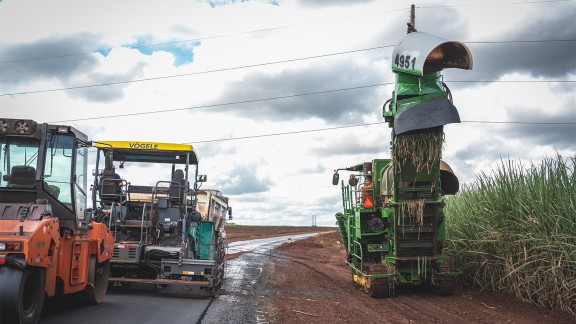
Usina Alta Mogiana in São Joaquim da Barra, in the north of the São Paulo region, is a big player in both the sugar cane and cane sugar markets: it has an annual production volume of more than 10 million sacks of crystalline sugar and hundreds of millions of liters of ethanol biofuel. The pressed biomass remaining after extraction of the raw cane juice is used to generate electricity to meet the company’s own needs, and any surplus power is fed into the grid. At the gigantic agro-industrial complex, around 300 machines – ranging from tractors to sugar cane harvesters – are at work during the harvesting season.
The internal road network on the plantation has an overall length of around 60 km – about the same as in a smaller city. However, in summer, the region is frequently plagued by torrential rain. This softens up the gravel tracks, causes wash-outs and makes the roads almost impassable. The consequence: high road maintenance and repair costs, extreme wear and tear, and costly repairs on the heavy goods vehicles that transport the harvested sugar cane from the fields to the sugar mill. At the same time, vehicles could only drive relatively slowly on the gravel roads. “We wanted to pave the roads with asphalt to improve the traffic flow and transport logistics on the plantation and increase safety,” explains Carlos Puerta, Head of Agricultural Crop Production.
Instead of commissioning a road construction contractor to carry out the project, the company decided to invest in its own road construction equipment. Together with the Wirtgen Group, Terraverde Máquinas, the region’s authorized sales organization for John Deere and Wirtgen Group products, made the customer a perfectly tailored offer. It went far beyond the usual offer of suitable machines. They also calculated the cost-effectiveness of the project and put together a package including extensive testing, support and, above all, a training course lasting several days. This was because Carlos Puerta not only wanted to make use of the off-season for the project; he also wanted the machinery to be operated by his own personnel.
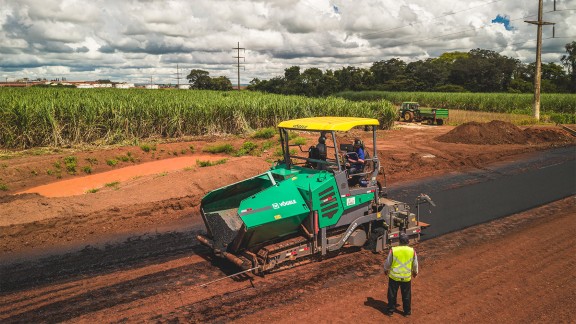
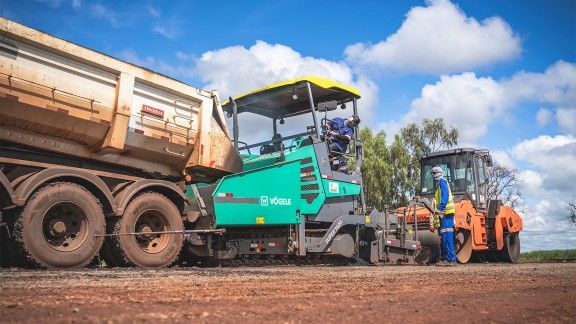
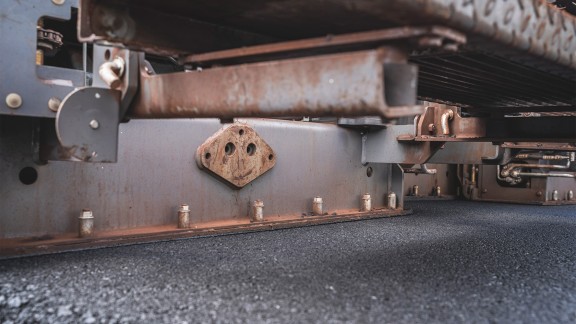
The choice was made: a Vögele SUPER 1400 road paver and a HD 90K roller from Hamm. The tracked paver is characterized by its robust undercarriage and material conveying system and compact dimensions that make it easier to maneuver on the plantation roads. In combination with an AB 480 extending screed including tamper and vibration compacting systems, the SUPER 1400 achieves a high degree of pre-compaction and paving widths between 2.55 m and 4.80 m and, with bolt-on extensions, even up to a width of 6.3 m – the ideal solution for the requirements in São Joaquim da Barra: The asphalt was paved in two strips with a width of 4 m, each with a 5 cm binder course and a 3 cm surface course, over the entire 60 km of the road network.
The machine’s powerful drive system and a laydown rate of up to 600 t/h reduced the weather-related risks on the project: the paving crew took full advantage of the short dry breaks in the weather and was able to pave relatively long sections at a time. At the same time, the efficient cooling system ensured reliable paving operations, even in the tropical heat and humidity.
“We have a long-standing partnership with John Deere, having worked with their agricultural equipment for many years. And now we are also working with Wirtgen Group machines for road construction. This is a strong, reliable partnership that we have every confidence in.”
Carlos Puerta, Head of Agricultural Crop Production
The applications and service technicians from the Wirtgen Group provided comprehensive training for the plantation workers with a particular focus on applications technology. Paving high-quality asphalt roadways was quite a challenging proposition for the agricultural specialists. In contrast, the operation and maintenance of the machines was comparatively easy even for the less experienced users: the ErgoBasic operating concept of the SUPER 1400 is highly intuitive and provides all basic functions for the realization of high-quality paving results. Logical symbols, a clearly laid out control panel, rugged operating consoles and easily legible function and status indicators assist the machine operator in all working procedures.
The effort and the investments paid off in the end: The asphalt paving considerably reduced Usina Alta Mogiana’s maintenance costs for the internal road network and its vehicle fleet, while the elimination of the need for road maintenance and repairs alone could well save the company annual costs of around 7 million reals (close to 1.2 million euros). At the same time, transportation times from the fields to the sugar mill are now shorter. Overall, it is expected that transport logistics costs will be able to be reduced by around 25%. Thanks to its own machines and trained personnel, the company is now also ideally prepared for the flexible expansion of the plantation’s road network should the need arise.
“White gold” from Brazil
Accounting for more than 60% of global production volumes, Brazil is the world’s largest producer of both sugar cane and cane sugar. Alongside the state of Paraná, the main growing region is in the state of São Paulo, where the fertile soil and favorable climatic conditions provide the ideal conditions for high yields. The crops are used not only for the production of crystalline sugar for the food industry, but above all for the production of ethanol, which is an important biofuel in Brazil. On top of this, the pressed sugar cane biomass – known as bagasse – is used for the generation of green power.
Road pavers
Screeds