Stringless Paving

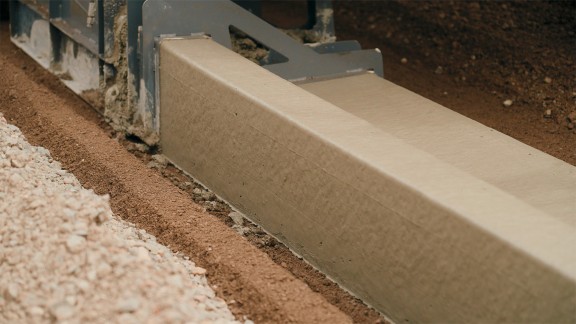
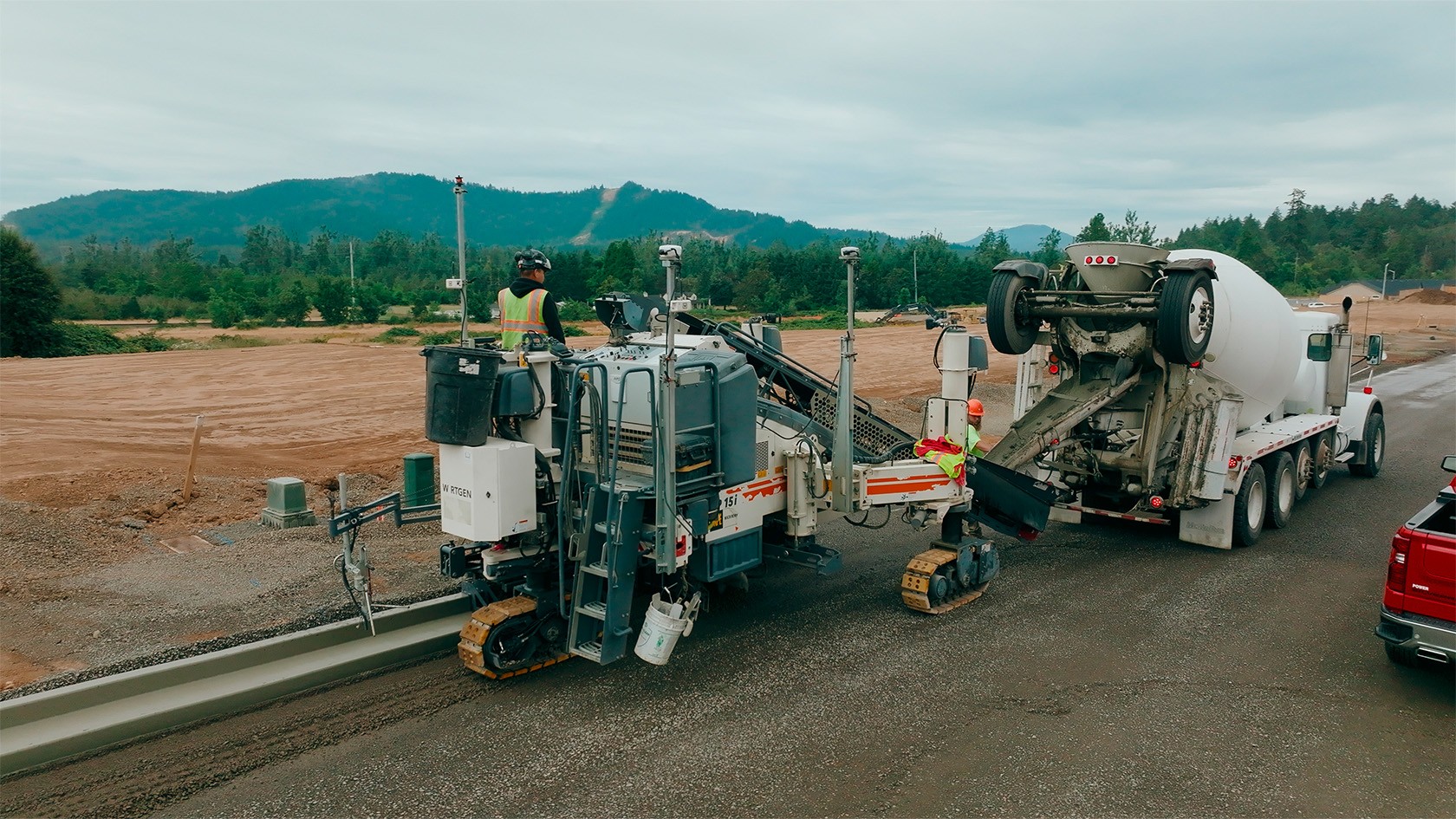
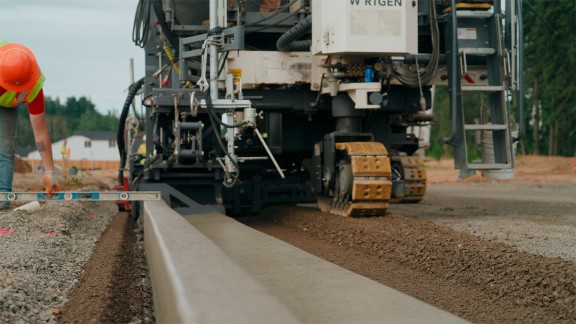
Oblique side view of the SP 15i paving curbs on a highway. Farmland and wooded hills in the background.

Efficient Concrete Paving in Oregon thanks to Wirtgen Slipform Technology

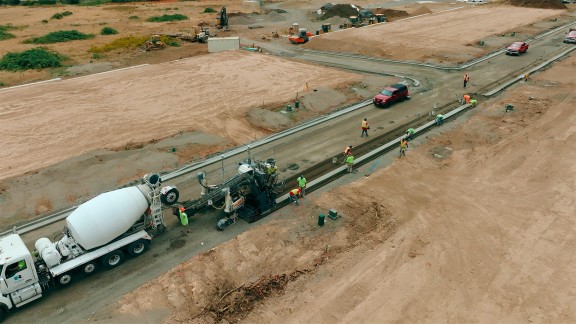
Concrete flatwork & paving specialists Roger Langeliers Construction Co. (RLC) produced curbs and gutters for a new housing development currently under construction in Springfield, Oregon. The use of a Wirtgen SP 15i with integrated Autopilot 2.0 made the construction process much faster and delivered precise paving results.

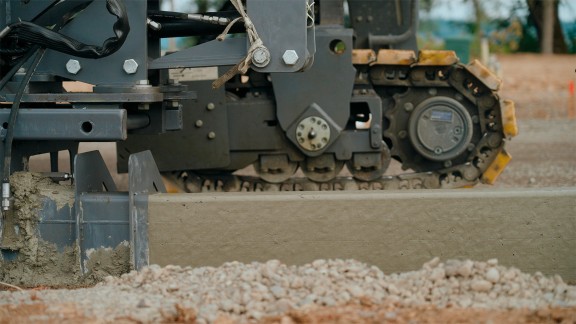
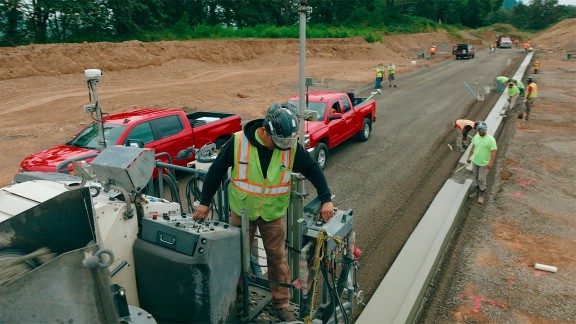
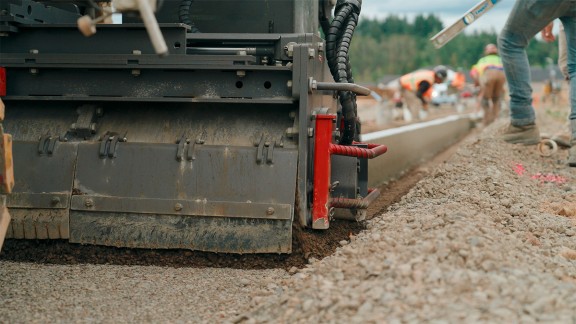
For the new housing development in Springfield, the American paving crew paved curbs and gutter profiles over a distance of more than 2,400 ft (730 m). The Wirtgen SP 15i played a decisive role in the fast completion of the paving project. The compact slipform paver can pave monolithic profiles up to a height of 4 ft 3 in (1.3 m) and narrow concrete slabs up to a width of 7 ft (2.1 m). This makes it particularly suitable for use on construction sites that demand extreme maneuverability, the paving of tight bends, and enormous flexibility. The two front crawler units with parallelogram swing legs and the movable rear crawler unit enable flexible adjustment to conditions on the construction site and seamless paving.

Stringless Profile Paving, Thanks to AutoPilot 2.0

The subsequent integration of the AutoPilot 2.0 stringless machine control system into the SP 15i made it possible to complete the construction project in Springfield particularly quickly and efficiently. The Wirtgen in-house development replaces complex surveying, the setup and break down of physical stringlines, and the creation of a geodetic data model. This significantly reduces the time and effort required and noticeably reduces costs.

What are the Advantages of AutoPilot 2.0?

Wirtgen AutoPilot 2.0 enables even more economical and precise paving of offset and inset profiles. The control system enables, for example, the paving of concrete safety barriers, curbs, traffic islands, or road surfaces with widths of up to 11 ft 6 in (3.5 m). The considerable time and effort for complex surveying work, setting up and breaking down stringlines is no longer required.

Instead, the AutoPilot 2.0 3D control system uses either an existing digital data model or creates a new model from data collected on the construction site. The software computes the ideal line for the concrete paving process from all the measured points. Two GPS receivers mounted on the machine communicate with a GPS reference station on the construction site. The global navigation satellite system (GNSS) automatically controls the steering and the cross slope of the slipform paver.

Wirtgen supplies AutoPilot 2.0 for the models SP 15i, SP 25i, and SP 33 and offers retrofitting for existing models.
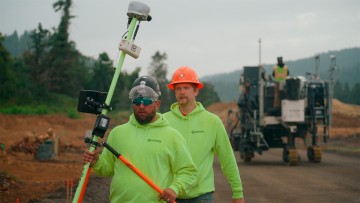
Two workers with a Field Rover survey pole and the SP 15i in the background.

In a first step, a Field Rover survey pole is used to define measuring points for the virtual stringline to be used by the 3D control system.

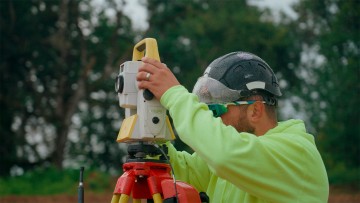
A worker recording a set point.

After recording the set points, the software computes a digital data model on the basis of which the SP 15i can pave along a virtual stringline.

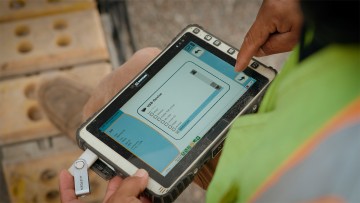
View of a tablet on which the software has calculated the ideal, virtual stringline.

The software calculates an ideal, virtual stringline from the measured points.

Quick and Precise Workflow Cuts Costs and Increases Quality

RLC invests in equipment that enables the best possible fulfillment of their clients’ quality targets and deadlines. At the same time, the company is focused on assuring that operators can work safely, quickly, and comfortably. The SP 15i is a good example of this. For Project Manager Thomas Kallai, the integration of AutoPilot 2.0 raises the construction process to an entirely new level. Thanks to stringless paving, the process is not only more cost-effective, but also much faster and more precise in comparison to previous methods.

Photo: Thomas Kallai, Project and Training Manager at Roger Langeliers Construction Co. (RLC)

“We’re working with a Wirtgen SP 15i, running AutoPilot for the whole project. It took us about two or three hours to shoot the 2,400 feet (730 meters). Then, we upload all the information to the tablet on the machine, and away it goes.”

Thomas Kallai, Project and Training Manager at Roger Langeliers Construction Co. (RLC)

Tremendous time savings for the project setup

Thomas Kallai joined RLC as a machine operator in 2016. In the meantime, he works as a project and training manager. He is particularly proud of how perfectly everything meshes in his well-practiced team, and that the paving crew works more confidently and with added automated functions through all stages of the work with the SP 15i.

“If we were to set a stringline, it would take two guys about eight hours to get it all ready to go,” explains Kallai, reflecting on the old-school workflow versus what his crew did that morning. “This job took us three hours, maybe four because I was training someone. By myself, I could probably shoot it in two and a half hours from set up to break down. So, it’s at least 50 percent faster most of the time.“

Easy Operation, Good Visibility

The paving crew particularly appreciated how quickly and easily they were able to learn how to operate the machine. The Project Manager is also impressed by the good visibility: “The operators can see everything and don’t have to worry about running over something with the tracks. There’s more room to move around on top of it – and there’s even a cup holder!”

No More Complex Surveying and Setting Up and Breaking Down Stringlines, Thanks to AutoPilot 2.0.

His colleague, operator Kevin Valentine, can only agree. “I’ve been using the SP 15i for two years now,” he reports. “It’s really very simple. Anybody could turn it on, learn it, and operate it fairly easily.”

Photo: Kevin Valentine, Machine Operator at RLC

“It’s really very simple. Anybody could turn it on, learn it, and operate it fairly easily.”

Kevin Valentine, Machine Operator at RLC

Low Fuel Consumption, Reliable at Work

  • Low fuel consumption: “The fuel consumption is a game changer for us,” explains Kevin Valentine. We can run two huge jobs, without fueling up for three days. In ECO mode, the machine automatically adapts the power requirement as soon as we turn on the Trimmer or the conveyor belt.”
  • Less prone to breakdowns: Valentine is also responsible for monitoring the SP 15i’s vitals, sharing that the machine is less bothersome than others in the RLC fleet. “We used to fill up the DEF fluids all the time. With the SP 15i, if we’re constantly using it, I don’t have to fill up the DEF fluids for about four days,”
  • Quick mold changing: For Thomas Kallai, the time saved when changing the mold, which can be done on-site, is a big advantage. “It’s a well-balanced machine. So, it’s very easy to move from job to job. Setup is fast,” says Kallai. “Everything is also easy to swap over. When we change the mold, the machine picks up the mold, we flip a switch, and the mold walks itself onto the machine.”

Fast Start-Up and Excellent Local Service

Initially, Thomas Kallai was a little skeptical when the first SP 15i – at the time without AutoPilot 2.0 – arrived on the construction site. Nevertheless, the switch from the machines he had used so far to the Wirtgen machine turned out to be absolutely smooth and seamless. That was also due to the comprehensive support of the Wirtgen team. “When we got the first machine, we were on stringline. Fortunately, representatives from Wirtgen joined us for a few days on the job. They showed us how to run and maintain the machine and all the features.”

A year later, Kallai and his crew got another visit from the familiar faces of the Wirtgen service team when the AutoPilot 2.0 3D system was retrofitted onto the machine. “The Wirtgen reps came back and worked on several jobs. They taught us how to shoot it, adjust the machine for steering or elevation, and then helped us work out any issues we had while shooting the job. So it was very helpful.”

About Roger Langeliers Construction Co. (RLC)

RLC is a 100 percent employee-owned company specializing in precise placement, expert finishing, meticulous sawing, and joint sealing of Portland Cement Concrete (PCC). RLC stands for highest quality in commercial building construction projects of all sizes and complexity and operates from four full-service offices and stores in the cities of Bend, Coburg, Hillsboro, and Medford, Oregon. The driving force behind its success lies in its around 150 employees, who constantly strive to make RLC the contractor of choice for potential clients through their regular training and active teamwork. On top of this, the company pursues a zero-accident strategy driven by personal responsibility and accountability for mutual safety.

RLC has been a trusted partner for slipform concrete paving services in the State of Oregon for over 30 years. Founded in 1995, RLC specializes in the processing of Portland cement and offers a portfolio of services including the paving of precise, durable surfaces for a variety of applications.

You can find more details and further information on our product pages.