Highway Rehabilitation in the Hocheifel Region

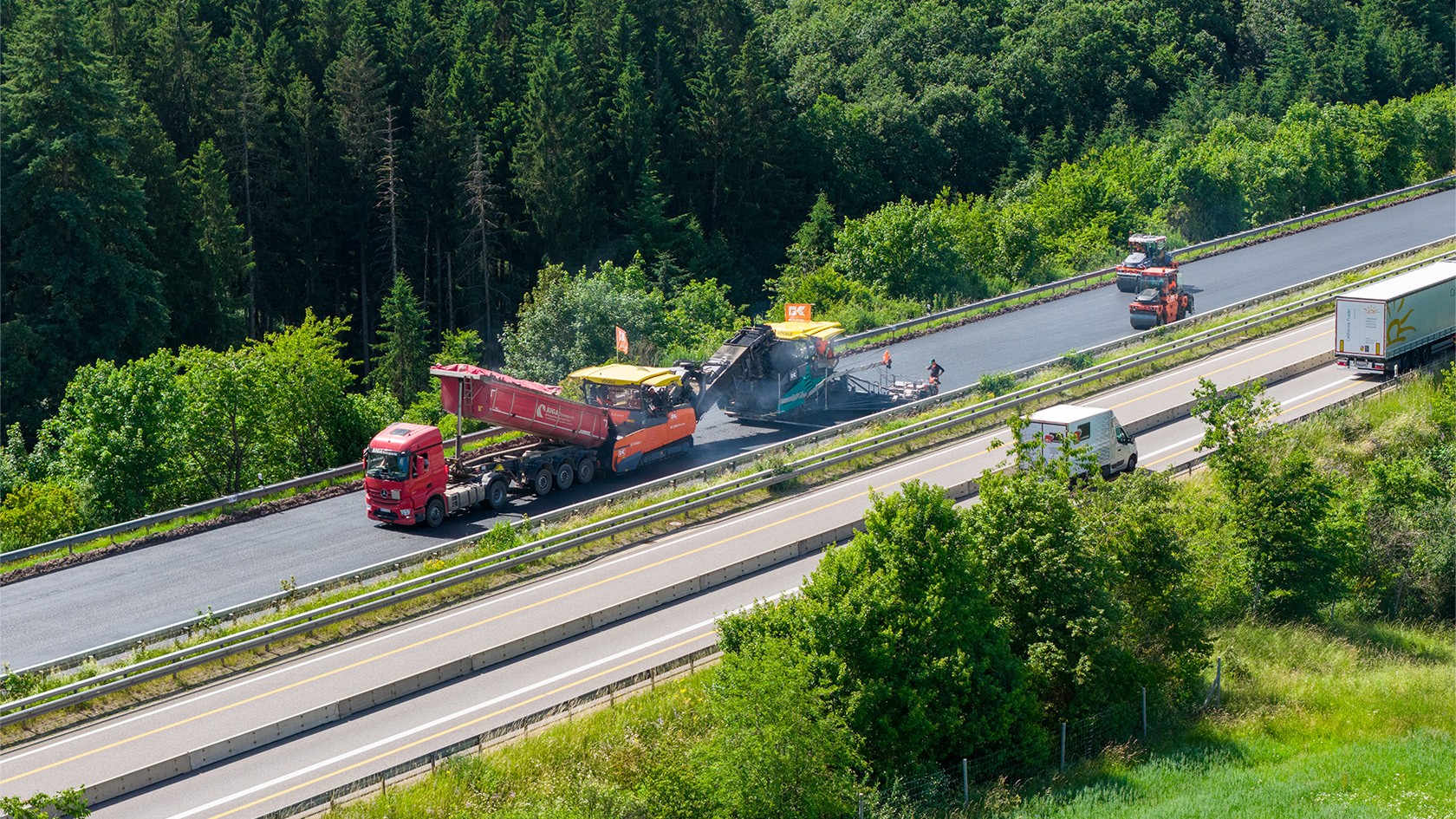
Aerial view of a paving train consisting of a mobile feeder, a paver, and rollers rehabilitating one lane of a highway embedded in a green landscape.

June 2026 | Reading time: 7 min

The Ideal Team for Challenging Infrastructure Projects

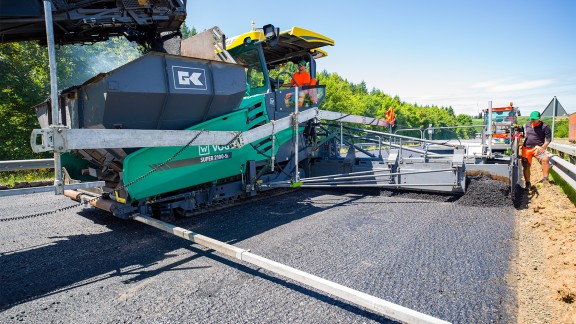
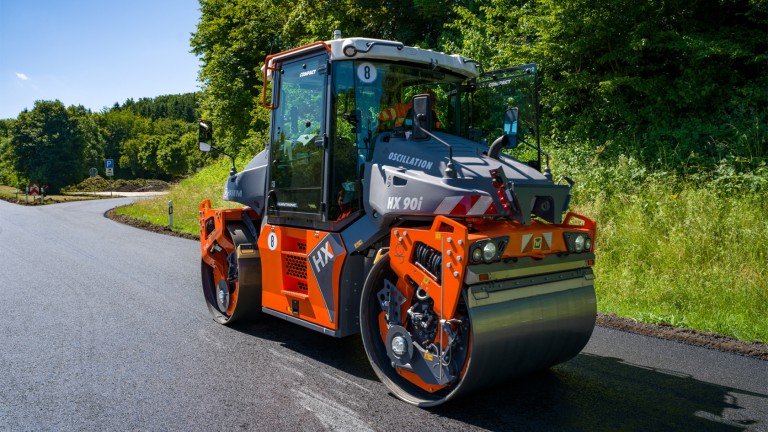
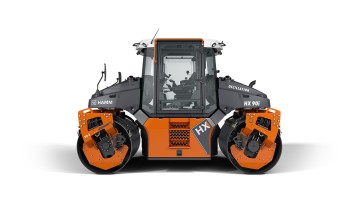
A SUPER 2100-5 X paver with a 12-meter screed and a Hamm HX 90 tandem roller equipped with Smart Compact Pro worked together on the project

On the A60 north of Bitburg, the surface layer and binder course of a section of the highway with a length of 3.5 km were badly in need of rehabilitation. The project was carried out with state-of-the-art machines from the Wirtgen Group. They enabled the contractor that was awarded the job to effortlessly fulfill the tight completion deadline specified by the highway authority and simultaneously assured the required paving precision. Thanks to smart technologies like the new Smart Compact Pro, this was an easy job and required no additional effort.

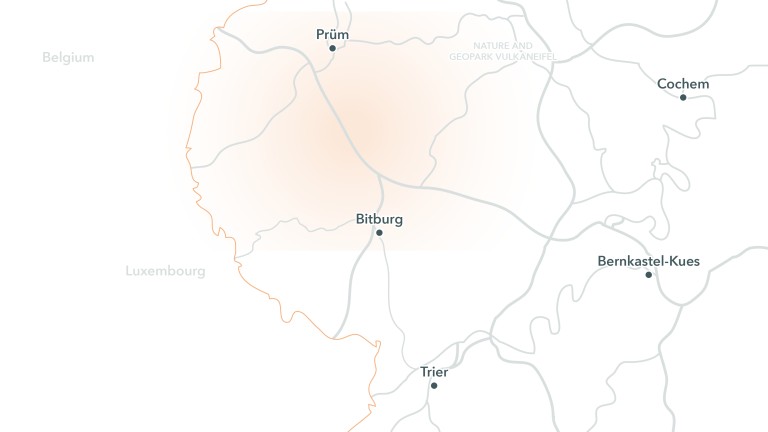
Map showing the location of the construction site.

In the heart of the Hocheifel region, not far from the Belgian border, the A60 winds through the countryside like a gray ribbon. Well over half of the 20,000 vehicles using the highway every day are trucks, which seriously impact the asphalt surface. In the past, only minor repairs had been carried out on the section between the Heisdorf viaduct and the Waxweiler interchange; however, the roadway on this section was now so badly damaged that a complete renewal of the surface layer and the binder course over a distance of around 3.5 km was the only viable option.

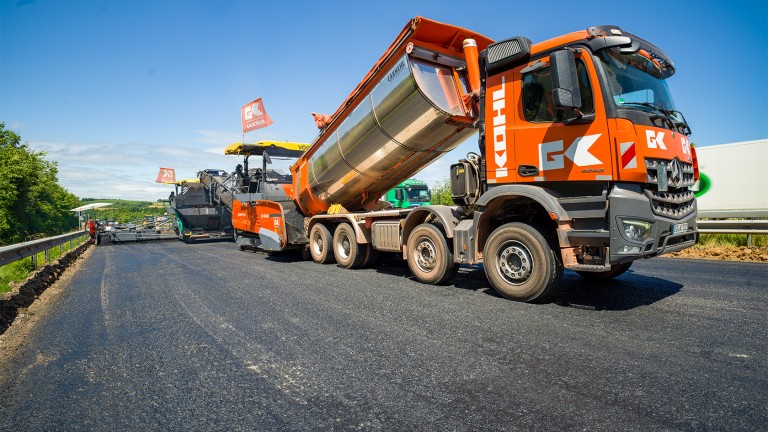
After the removal of the damaged asphalt pavement, the next task for the Kohl Bau construction crew was the paving of the binder course. After four days, the crew would have paved 11,000 tons of fresh asphalt mix. To ensure maximum reliability and surface precision, the paving contractor from Irrel relied on products from the Wirtgen Group. For asphalt-construction manager Michael Hansen, quality is the top priority. “We always make every effort to deliver 105% perfection. The road will get bad enough afterwards on its own,” he says with a grin.

Improved User-Friendliness and Comfort in the Dash 5 Generation

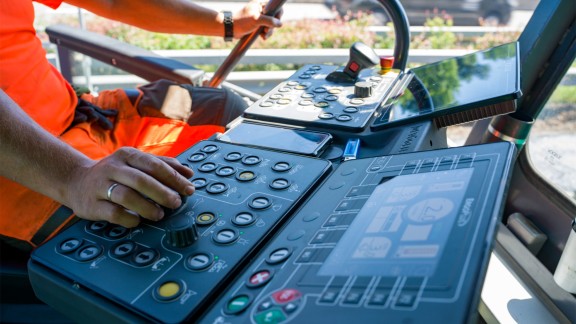
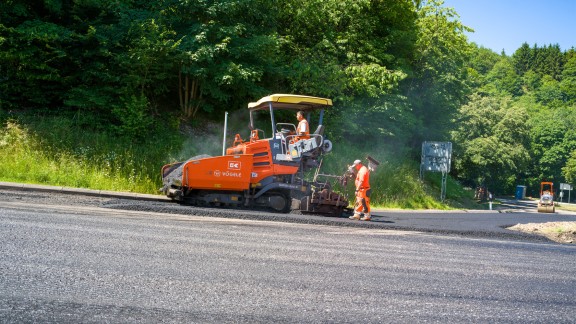
The new Dash 5 generation of the SUPER 2100-5 X Highway Class paver makes it even easier to fulfill these self-imposed high standards. Numerous assistance systems reduce the workload of the paver and screed operators. With a theoretical laydown rate of up to 1,100 tons of asphalt per hour, it offers sufficient output for challenging large-scale projects like this. Alex Bolinger has been working in asphalt construction for the past 20 years. He spent his first five years on the screed and has now been on the operator’s platform since 2010. From up here, he has the best possible overview of the construction site. Today is the first time he’s had the chance to work with the new paver. “On the face of it, the procedure is exactly the same: we have to get the mix onto the machine and then pave and compact it. But the comfort and ergonomics on the new machine are now even better.”

Seamless Paving with the SB 300 TV

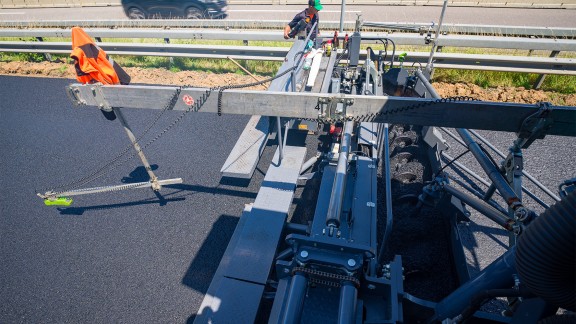
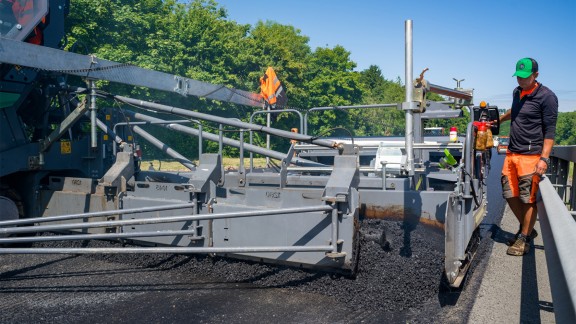
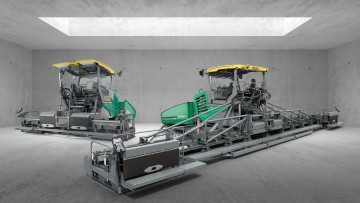
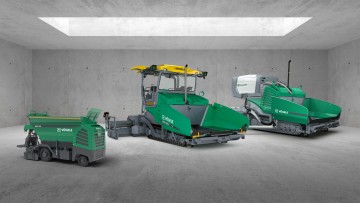
In order to easily achieve the evenness required by the highways authority, Autobahn GmbH, and produce a long-lasting pavement structure, the contractor decided to deploy a SUPER 2100-5 X paver fitted with an SB 300 TV screed with a width of 12 meters. This configuration enabled the paving of the entire roadway including the hard shoulder in a single pass. This also eliminated a potential weak point in the form of a central joint. The two screed extensions are hydraulically adjustable up to a total of 2.5 m and give the paving crew plenty of flexibility. Only in the area of the acceleration and deceleration lanes leading to the Prümer Land rest stop on the section is the roadway wider than the working width of the installed screed. A second, smaller, SUPER 1300 paver was used here to make up the difference.

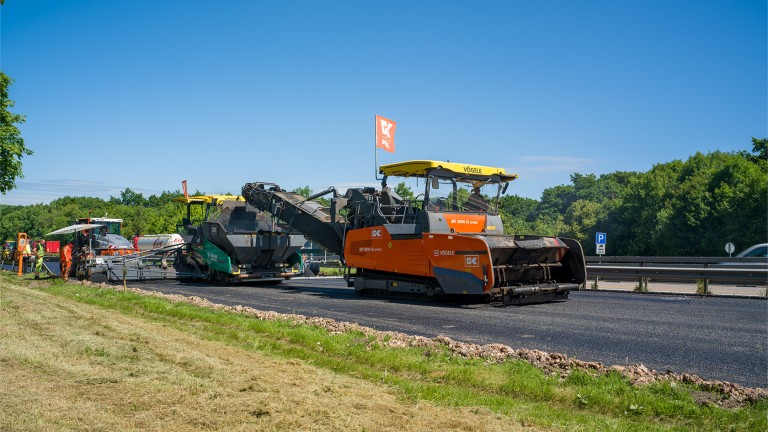
The mobile feeder transfers the mix to the paver.
The uninterrupted supply of asphalt to the site is guaranteed by a Benninghoven Retrofit and Vögele mobile feeders.

Paving such an enormous width poses particular challenges for the site logistics. The asphalt is supplied by the contractor’s two asphalt mixing plants. Only a few years ago, Kohl Bau upgraded one of them to the latest standards with components from Benninghoven. The members of the paving crew all agree: “If we hadn’t have had our own mixing plants, we wouldn’t have been able to get the job done so smoothly.” Twenty trucks worked full-time getting the asphalt mix to the construction site. But the bottleneck was the site itself: “When the traffic comes to a standstill in the narrow bit, we have to stop what we’re doing, too. There’s no other way to get onto the construction site, even though the mixing plants are located in different directions.”

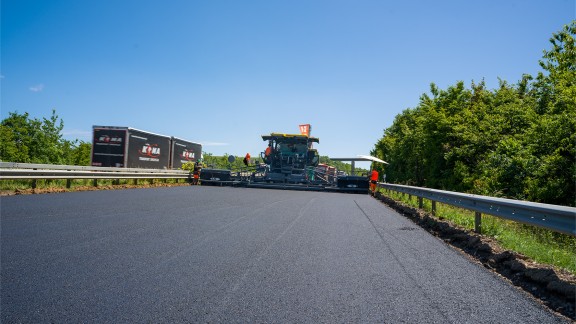
But on this day, there were no problems at all. Load after load is emptied into the Vögele MT 3000 mobile feeder, which is responsible for assuring a continuous flow of asphalt mix to the paver. This machine combination and an extra material hopper ensure an uninterrupted supply of asphalt mix for paving. Meter by meter, the machine train moves forward, closely followed by several rollers that ensure optimal compaction of the new asphalt pavement.

Tolles Produkt

Smart Compact Pro

Smart Compact Pro –Realtime Density Scan

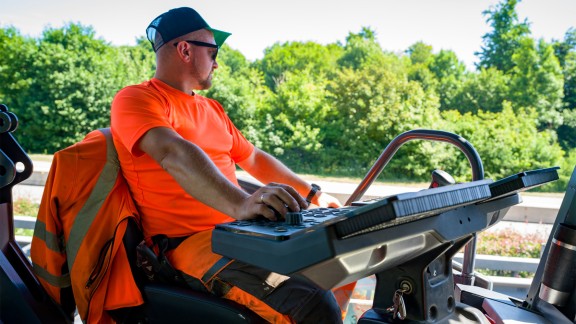
The star player in the team: a new HX 90i VS-OS tandem roller from Hamm. So what’s so special about this machine? It’s one of the first rollers to be equipped with the newly developed Smart Compact Pro system. The system uses a new sensor –the Realtime Density Scan – to determine the density of the compacted asphalt in real-time and uses this value for automated control of the compaction force and modes in both drums. This development is a significant step forward in asphalt compaction, because: as all industry experts agree, the real-time density is the decisive parameter for the assessment of quality during compaction. Until the development of Smart Compact Pro, this value was always the missing piece of the puzzle in asphalt compaction. Vitalij Koch in the driver’s seat of the HX 90i. Today’s the first time he’s used the new assistance system, too. “Driving a roller always looks so easy. Nevertheless, you do have to pay attention to how you drive and how many passes you’ve done. You have to have a feeling for the roller and the asphalt. The new system makes everything much easier for newcomers to the job. The vibration or oscillation is automatically activated with the required compaction force and deactivated again once the required density has been achieved. In my opinion, the system’s really good.”
Tolles Produkt
Smiling roller driver looking out of his machine.

“I’m definitely going to tell my boss he should invest in this system!“

Vitalij Koch, machine operator at Kohl Bau

Better Control and Cost-efficiency on the Construction Site

Another major advantage of using Smart Compact Pro is particularly appealing to construction managers and contractors: The continuous measurement of the real-time density eliminates the need for extremely time-consuming and costly drilling and core sampling. Regulatory requirements are also strictly implemented, which significantly minimizes the risk of financial penalties. The resulting density maps can also be documented and submitted to the client as proof of performance. Even inexperienced operators can achieve optimum compaction results with Smart Compact Pro without extensive prior knowledge. This is a particularly valuable aid to construction companies in view of the increasing shortage of suitably qualified personnel.Smart Compact Pro} makes a significant contribution to extending the service life of roads through automated compaction based on real-time density, which, in turn, reduces both short- and long-term construction and maintenance costs.

Details and further information can be found on our product pages.