Paving the Way with Wirtgen
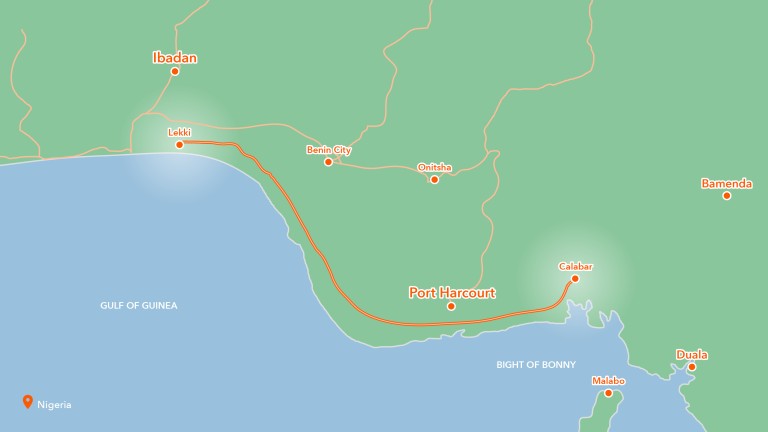
Construction of the Lagos-Calabar Coastal Highway

Construction of the Lagos-Calabar Coastal Highway
October 2026 | Reading time: 7 min.
The demands placed on a major arterial highway of this category are high. High degrees of evenness and durability are essential for the new road and, consequently, also for the success of this ambitious project. Independent of the expected heavy traffic and adverse weather conditions, the road surface must fulfil the required standards. Consequently, the decision was quickly made to use concrete – or, to be more precise, the CRCP construction method. “Continuous Reinforced Concrete Pavements” are heavy-duty concrete highways constructed with continuous steel reinforcing bars (rebar) and very few transverse joints. The reinforcement is not, as is frequently the case, found only at expansion joints, but extends through the entire concrete slab construction and lends it extremely high strength and durability over many decades to come. CRCP also offers considerable advantages in terms of surface quality and reduces the amount of maintenance required. This construction method therefore ensures that the road will deliver outstanding performance throughout its entire life cycle. The high proportion of rebar increases the structural stability of the construction, while the continuous, full-width paving process with a slipform paver guarantees a flat and even surface. Decisive factors for ride comfort and long-term usability.
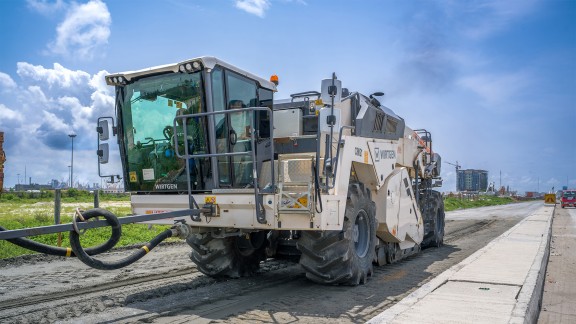
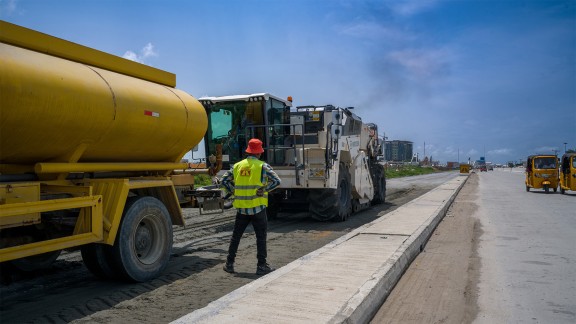
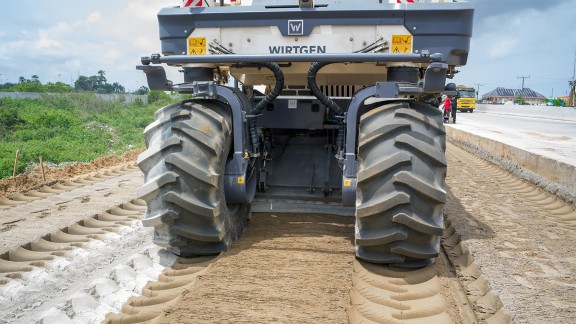
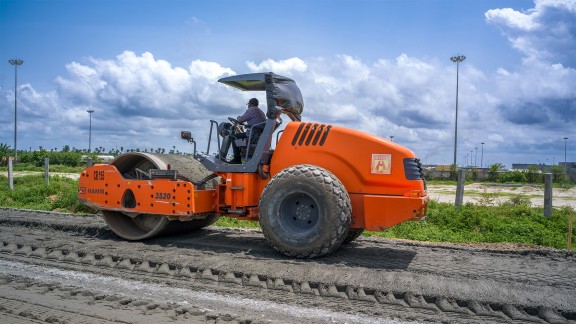
Every road is only as good as the ground it is built on. The bearing capacity of the subgrade first had to be improved to provide a stable foundation. The preparation process begins with stabilization by the WR series machine, which mixes a pre-spread stabilising agent and water into the soil with its mixing rotor and transforms it in-place into a homogeneous construction material. After processing, the mix produced in this way is extremely water- and frost-resistant, and therefore particularly suitable as a bearing substrate. After this, several Hamm compactors take over and produce an even, homogeneously compacted surface. This creates ideal pre-conditions for the subsequent steps.
In comparison to soil replacement, the benefits of this approach are resource-efficiency, fewer material transport movements, shorter construction times, lower costs and consistently high quality.
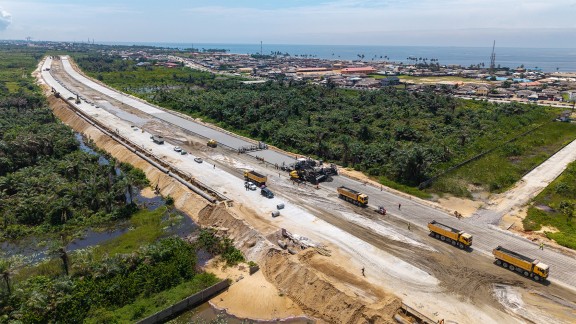
From soil stabilization to concrete paving: lead contractor Hitech Constuction Company Limited is relying on state-of-the-art machines, technologies, and support from the Wirtgen Group.
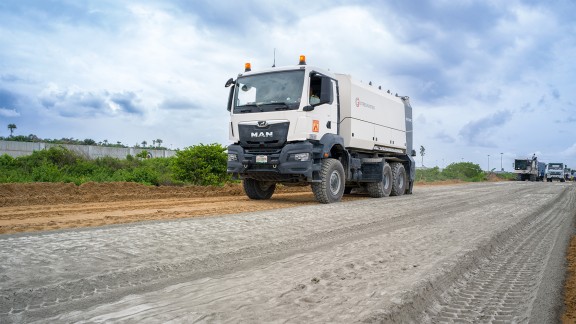
The pre-placed steel rebar mats not only lend the construction outstanding stability, they also bring a number of challenges. The concrete has to be placed over the rebar mats from the side, as concrete mixers or tippers cannot drive over them.
Continuous reinforcement in the form of steel rebar mats for the CRCP method means that the concrete has to be placed from the side
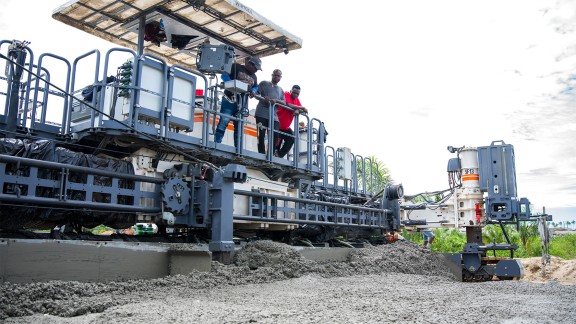
Often, an excavator or a wheel loader is used for pre-placing the mats and distributing the concrete on the surface. Here, it must be taken into consideration that the paving speed of a slipform paver essentially depends on how quickly and homogeneously the concrete can be placed and spread. Considering the broad paving widths achieved by the slipform paver used on the Coastal Highway project in Nigeria, the excavators or loaders would soon be pushed to their limit in their attempts to supply it with enough concrete. And that is exactly why the paving crew from Hitech is using a WPS 102 placer/spreader for placing and spreading the concrete in each of its paving trains The concrete is offloaded from trucks directly onto the folding belt conveyor unit of the WPS from the side. The belt conveyor unit transports the material received from the truck to the middle of the road. The placed concrete is then spread with a spreading auger across the entire width of the road without compaction. This ensures that the slipform paver can maintain a constant paving speed without interruptions. Excavators are then only used in a supporting role, like when the concrete is incompletely offloaded from a truck.
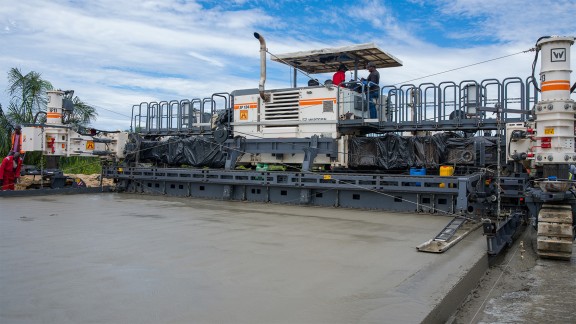
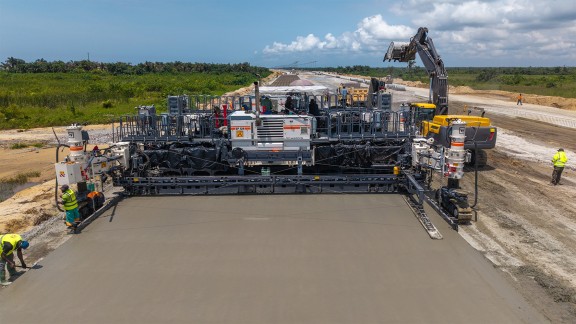
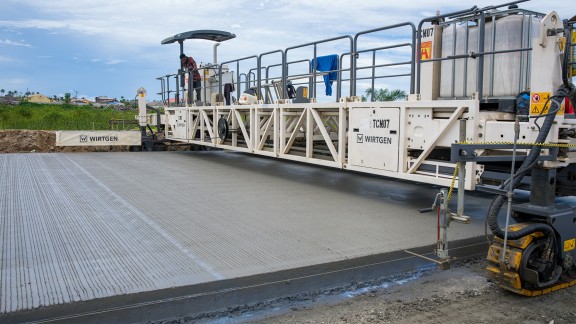
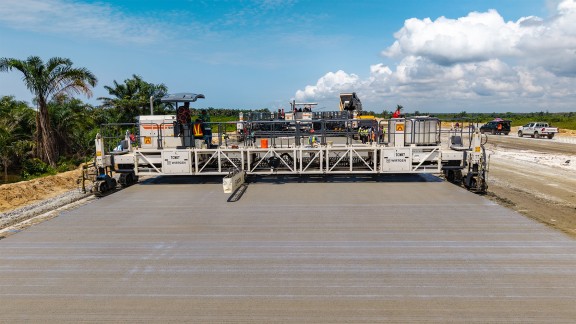
Several Wirtgen paving train were used in the construction of the Lagos-Calabar Coastal Highway. Each train was made up of a WPS 102 placer/spreader, an SP 124 slipform paver and a TCM 180 texture curing machine. The road was paved to the full-width of 12 meters in a single, continuous operation. On the one hand, this setup reduced the number of joints in the construction to a minimum and, on the other hand, significantly reduced the number of passes and required process steps while simultaneously guaranteeing highest precision. Following on behind the slipform paver, the texture curing machine TCM took over and applied an emulsion to protect the freshly paved concrete against premature drying. The efficient workflow ensured consistent quality across the full width of the roadway and from end to end of the entire paving project. How important logistics, planning, and support can be on projects of this magnitude, was very soon made clear by the documented data from just one of the paving trains.
Data from one of the paving trains:
Several paving trains work in parallel
Altogether around 100 Wirtgen Group machines were deployed on this project These included several Wirtgen offset slipform pavers, paving trains consisting of WPS 102, SP 124 and TCM 180 machines, WR series machines, Streumaster binding agent spreaders and several Hamm compactors.
Lead contractor, Hitech, relies on Wirtgen Group machinery not only because of the technology, but also, and in particular, because of the comprehensive support provided throughout the project. From the initial planning phases to it’s realization on the construction site to the continuously provided maintenance and repair services, the collaboration was characterized by the common goal of delivering nothing less than the best. Training sessions and courses, technical support and sharing experiences and expertise on the construction site are integral elements of this fruitful collaboration. The Lagos-Calabar Coastal Highway Projekt is therefore not only an example of modern road construction technology, but also a strong testimonial to what can be achieved through genuine partnership.
The Lagos-Calabar Coastal Highway is one of Nigeria’s most important infrastructure projects. Durable concrete roads will connect important commercial centres along Nigeria’s Atlantic seaboard. Shorter journey times, stronger integration of rural regions and better access to jobs, education, and healthcare facilities will be some of the enduring consequences of this ambitious project.