On the Construction Site of Tomorrow
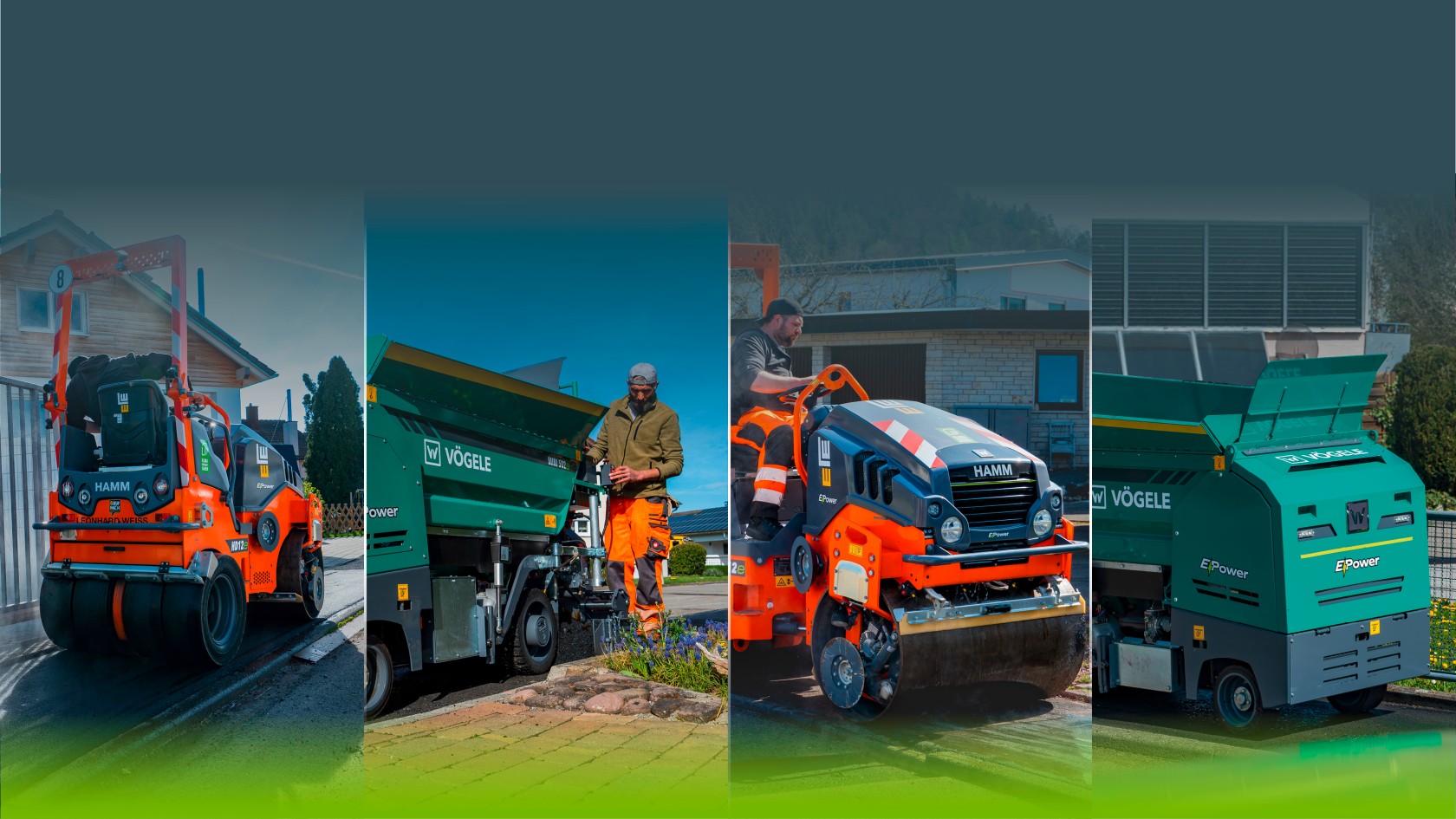
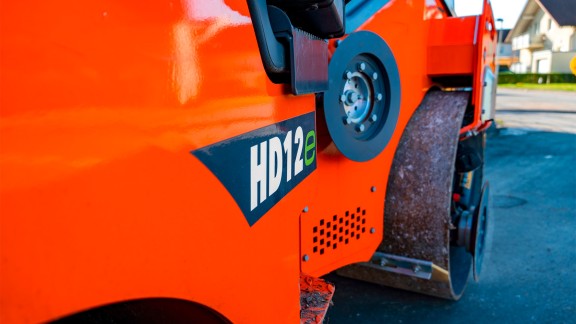
Composite image of the Hamm HD 12e VT tandem roller and the Vögele wheeled paver MINI 502e

All-Electric Paving and Compaction

In Rangendingen, in the German federal state of Baden-Württemberg, Leonhard Weiss is counting on the concept of an all-electric construction site with e-machines from Hamm and Vögele to make the construction process safer and more cost-efficient and simultaneously reduce noise and CO₂ emissions.

Will construction sites with purely electric machine power soon become the standard? What changes does this development bring to the construction process and how do employees and nearby residents benefit from this technology? Construction contractor Leonhard Weiss has already gathered initial practical experiences with electrically-powered construction equipment and now wanted to know more about it. In the course of a power grid upgrade project in Rangendingen, Baden-Württemberg, only fully electric machines were used, including a Hamm roller and a Vögele wheeled paver.

Pioneering Project

The pilot construction site in Rangendingen is part of the “NETZbaustelle der Zukunft” (GRID Construction Site for the Future) – an ongoing program initiated by Netze BW., the largest grid operator for power, gas and water in Baden-Württemberg. The pilot project served as a test to determine which measures can be used to carry out tomorrow's construction in a lower-emission, quieter, more digital and safer manner. On this and other pilot construction sites, the power grid operator initially investigated the technical feasibility and the effects of the use of all-electric construction equipment on the construction process.

E-Machines from Vögele and Hamm

The road construction work followed on from the earthworks with electric construction equipment. Two new additions to the contractor’s fleet were used for the paving and compaction of the asphalt layer: a HD 12e VT tandem roller from Hamm and a Vögele wheeled paver MINI 502e. The machines work with extremely low noise and local zero operating emissions, and are thus the ideal choice for use on urban construction projects with strict emission regulations. Their drive and material conveying systems and the wheeled paver's screed heating are fully electrically powered and are characterized by low energy consumption. And the upshot is: both machines are in no way inferior to their diesel-powered counterparts in terms of quality and efficiency.

“We are pleased to be able to contribute to the reduction of noise and environmental impact here on the site through the use of all-electric construction equipment.”

Jean-Pierre Liedtke, Site Manager at Leonhard Weiss

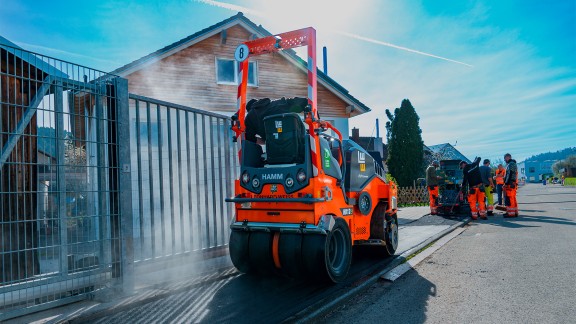
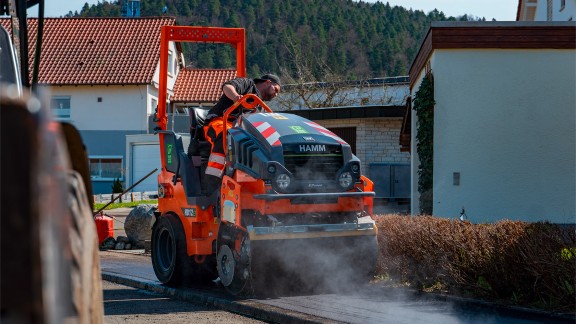
HD 12e VT compacting the asphalt layer on a sidewalk with houses in the background.

HD 12e VT –
100% Compaction Performance with Local Zero Operating Emissions

  • Local zero operating emissions with all-electric drive system
  • Reduced noise emissions
  • Battery: equipped with a 23.4 kWh lithium-ion battery
  • Operating weight:2,670 kg
  • Centrifugal force:41/25 kN
  • No comprises in compaction performance
  • Maximum efficiency ensures high running and operating times
  • Sufficient power for a typical working day
  • Almost identical operating concept to that of the diesel-powered variants

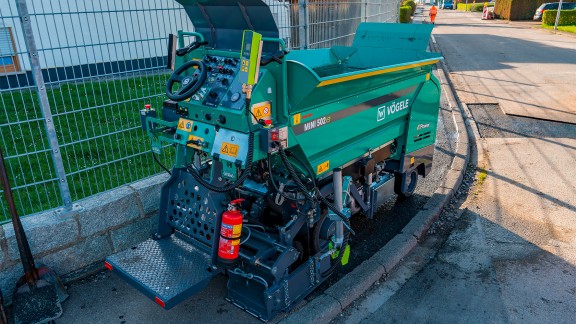
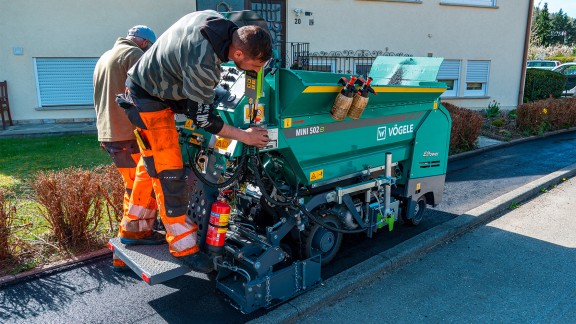
Wheeled paver MINI 502e paving an asphalt layer on a sidewalk in Rangendingen.

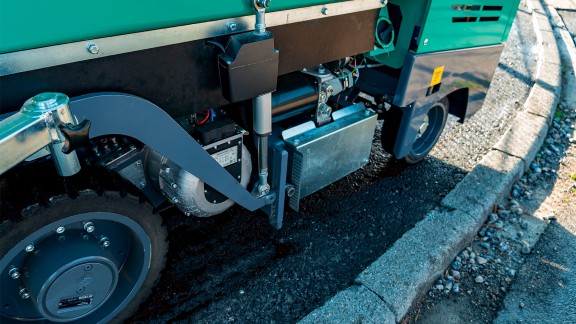
Wheeled paver MINI 502e – Low-Noise Asphalt Paving

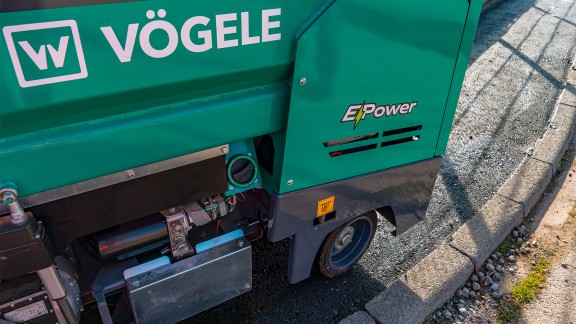
  • The battery-electric drive enables local zero operating emissions
  • Battery: standard variant with a storage capacity of 15 kWh, the optional variant with 22 kWh was used in Rangendingen
  • Running time: up to two days of paving, depending on the variant
  • Operating weight: 1,350 kg
  • Paving widths: 0.25 m to 1.80 m, particularly suitable for small radii
  • Laydown rate up to 20 t/h
  • Ideal for urban paving applications
  • Almost identical operating concept to that of the diesel-powered variants

Before Work Begins: Fast and Easy Charging

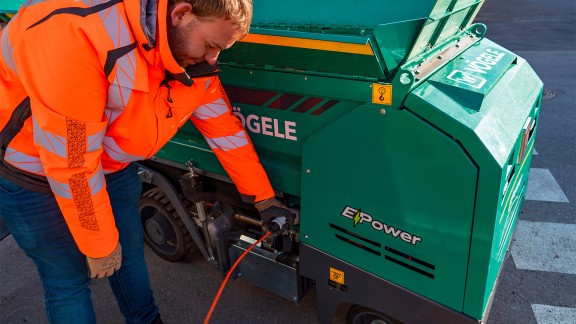
Both machines began their day’s work in Rangendingen with batteries fully charged through the night before – enough power to complete the construction project without topping up the batteries. Both the wheeled paver and the roller had sufficient power for a running time of up to two days of paving.

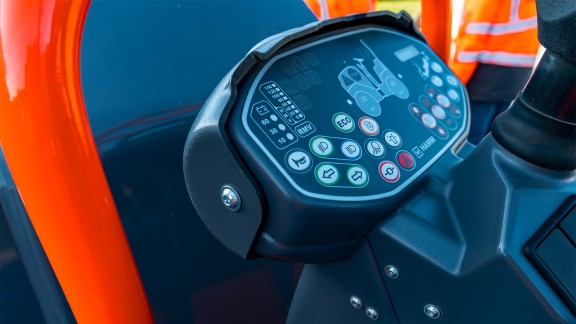
In addition, the machines were able to be charged at the power distribution boxes on the site, which enabled the paving team to familiarize themselves with the charging process. The current battery charge level of both machines could be quickly and easily read from the clearly laid out control panel.

The Core Element:
the Battery

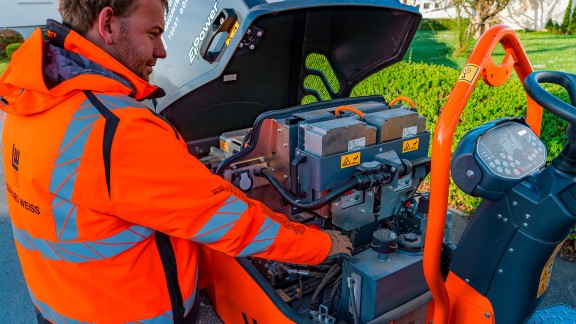
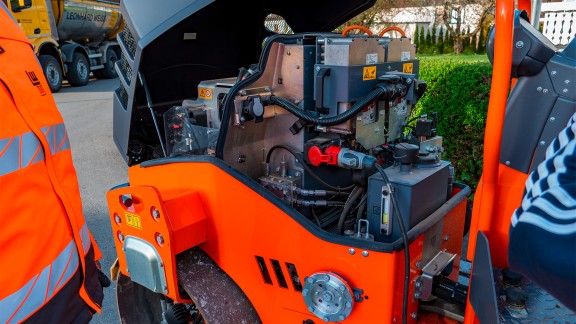
Lithium-ion batteries supply the power for the drive systems. In the case of the Hamm roller, the rechargeable battery with a capacity of 23.4 kWh is permanently integrated in the machine. It can be charged in two ways: via a rapid charging plug (400 V, CEE) or via a plug with a Schuko adapter (230 V). The battery for the MINI 502e is available in two different variants – with a capacity of 15 kWh or a capacity of 22 kWh. The charging itself was carried out via a standard 230-voltSchuko mains power socket.

The charging time for the HD 12e VT is around 4 hours, while charging the MINI 502e takes between 5 and 7 hours, depending on the battery variant used.

Quick Paving of the Asphalt Layer

Work got started with the MINI 502e. The clear advantage: controlling and monitoring the paving process was just as easy and comfortable as with the diesel-powered machines. What followed on from here called for precision. The repair work on the narrow, partly winding sidewalk on Königsberger Strasse would not have been possible with larger machines. In contrast, the compact wheeled paver needs very little space to maneuver and has a small turning circle. This enabled it to pave the 290 m long and 1.00 to 1.30 m wide surface layer efficiently and in outstanding quality.

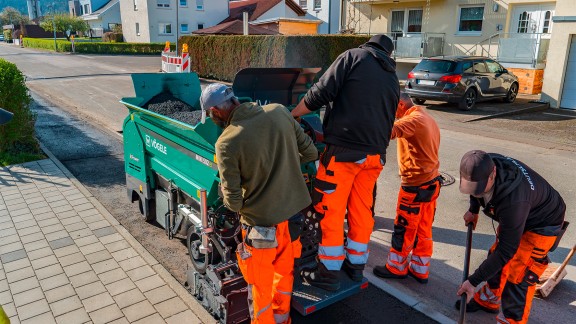
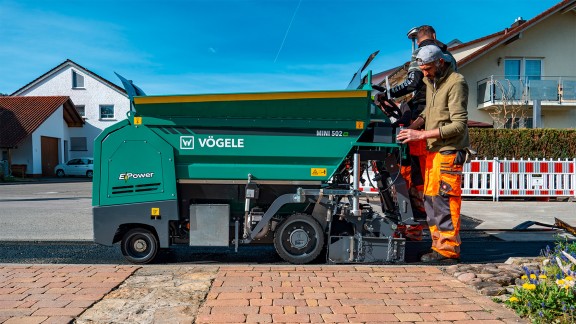
Material hopper of the MINI 502e, with worker checking the transfer of the asphalt mix.

Optimum Material Management

The MINI 502e has a large material hopper with a wide funnel-shaped opening, which was fed with material from the side by a wheeled loader. This made the transfer of the asphalt mix to the paver a particularly convenient and clean process. The asphalt mix was spread across the entire working width by two fully electrically-driven spreading augers.

High Compaction Performance

The Hamm HD 12e VT roller compacted the paved asphalt immediately behind the Vögele paver. It is also an extremely quiet and clearly laid out machine with a simple handling concept. The team on the construction site was impressed by the high compaction force and precision of the small electric roller, which can compact precisely up to edges. As is often the case on smaller construction sites, the HD 12e also played out its advantages as a combination roller. The combination of dynamic compaction via the smooth drum and the kneading and rolling action of the rubber tires not only enabled rapid compaction, but also ensured uniform surface sealing. By the way: in addition to the HD 12e VT, Hamm is also the only roller manufacturer to offer an all-electric combined roller with oscillation, the HD 12e OT.

At the End of the Day?

A positive conclusion: both machines are in no way inferior to their diesel-powered counterparts in terms of performance and ease of handling. On top of this, they also impress with a good energy footprint: electric motors draw power only when they are actually under load. This is how the concept of an all-electric construction site works: it pays off economically and perfectly positions the construction company for taking on future tasks, as even strict regulatory requirements regarding noise protection and CO₂ reduction are met.

Details and further information can be found on our product pages.