Mixing Close to the Construction Site.

The Wirtgen Cold Recycling Mixing Plant KMA 240(i) Expands the range of Applications

The Wirtgen Group offers a variety of solutions for the recycling and re-use of road construction materials such as milled material reclaimed during the removal of asphalt pavement in the course of road rehabilitation projects. One of these solutions is the KMA 240(i). This high-performance plant from Wirtgen is an ideal choice for resource-friendly and economical production of paving mixes close to construction sites. It enables contractors to convert up to 240 t of reclaimed pavement material into new, high-quality paving mixes per hour.

Optimum material flow in a perfectly coordinated system: Learn more about how a Wirtgen cold recycling mixing plant KMA 240(i) works.

The Production of Various Materials: from Bitumen-Bound to Cement-Treated Base Layer Mixes.

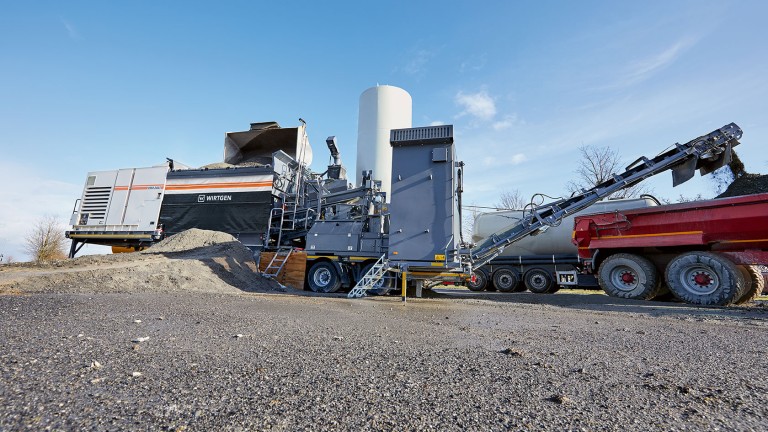
Mounted on a flatbed semitrailer, and equipped with its own engine unit, the new cold recycling mixing plant KMA 240(i) can be quickly and easily moved to a location close to a construction site and begin production more or less right away. This mobile configuration enables rapid redeployment of the plant to any other location. These proven advantages were also characteristic features of its predecessor from Wirtgen, the KMA 220(i). The engineers from Wirtgen have further developed, revised and upgraded the performance and precision of the plant. The outstanding features of the new KMA 240(i) include higher mixing performance and an innovative cement dosing system with automatic self-calibration controlled by static weighing. Fresh bitumen is added to the mix in the form of bitumen emulsion or foamed bitumen.

Thanks to its powerful six-cylinder diesel engine, the new, high-performance Wirtgen cold recycling mixing plant can process up to 240 t of material per hour. On a full tank, the engine provides sufficient power for up to two days of exceptionally economical production of recycled mix from a wide range of non-cohesive base materials – typically sourced from cold milling machines from Wirtgen. Low emission values mean the plant can also be used in urban areas. Thanks to the highly-effective soundproofing of the engine housing, plant operatives and local residents will particularly welcome the significant reduction of noise emissions.

Tolles Produkt

The hourly output of 240 t means:20 t of cold recycled mix every 5 minutes

Economical and Versatile: Cold Recycling with the KMA 240(i)

With in-plant cold recycling, a mobile cold recycling mixing plant (Kaltrecycling-Mischanlage - KMA) is set up close to the construction site. This saves time, minimizes transport movements, and contributes to efficient procedures on the construction site: Depending on the project specifications this can mean up to 60% lower CO₂ emissions through cold recycling, up to 50% shorter construction times and up to 50% lower construction costs.

The cold recycling mixing plant KMA 240(i) produces mix that can be paved immediately and is suitable for the production of various types of bound base layers. In addition to mix for cement-treated base layers (CTB) and roller-compacted concrete (RCC), the plant can also be used to produce bitumen-bound base layers by the addition of bitumen in the form of bitumen emulsion or foamed bitumen. The range of applications for the various mixes includes constructing freeways, roads and paths, and parking lots.

The new traffic and industrial infrastructures constructed in this way are characterized by a high load-bearing capacity, resistance to deformation and a long service life. Cold recycling technology from Wirtgen enables the re-use of up to 100% of the existing milled material and thus offers economically attractive savings potentials.

On the main control panel, the operator can keep an eye on the material flow diagram, machine status and the entire production process at all times.

The Advantages In Figures (project dependent)
Recycling of existing materials
as much as 100%
Reduction of material for disposal
up to 100%
Reduction of site transport logistics
up to 90%
Reduction of required resources
up to 90%
Reduction of binding agents
up to 50%

The Cutting-Edge Process Technology of the KMA 240(i) Enables Faster Mix Production

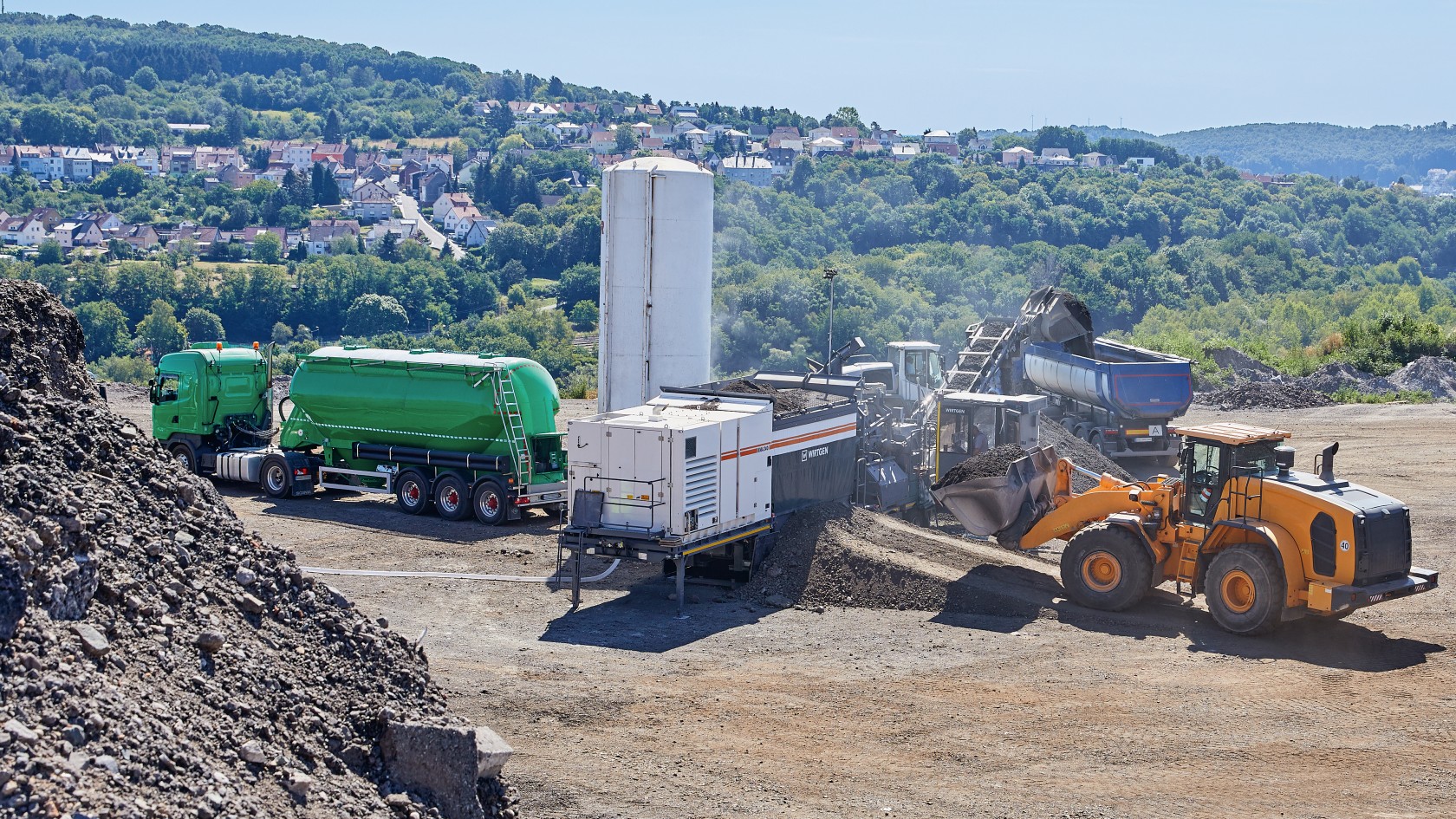
Thanks to microprocessor controlled plant control, the KMA 240(i) works with exceptional precision. The plant is supplied with binding agents such as hot bitumen, bitumen emulsion and cement from storage silos or tank trucks. The precise dosing of the base materials and binding agents in proportions determined beforehand in a road construction laboratory is monitored by a field-proven microprocessor control system. Ideally, the KMA 240(i) then loads the new, homogeneous construction material mixture directly onto trucks or continuously deposits it onto a stockpile.


The Paving Process with a Cement-Treated Base Layer (CTB)

5. Paving
1. Milling + Stabilizing
2. Transport / Unloading
3. KMA 240(i)
4. Transport from the plant to the construction site

Case study: New CTB at Paderborn-Lippstadt Airport

During the rehabilitation of the apron and the refuelling and de-icing area of Paderborn-Lippstadt Airport, the requirements included not only a high mixing capacity, but also an increase in the compressive strength of the new cement-treated base layer (CTB). On this project – one its first real-world tests – the KMA 240(i) processed 5,500 t of construction material in just 7 days to produce the required paving mix.

Prior to this, the lead contractor, Oevermann, had already milled off 15,000 m² of tarmac on the project site with a Wirtgen cold milling machine W 220(i) and had stockpiled the milled material on a neighboring parking lot together with crushed limestone 0/5 as an additive. A wheeled loader transferred both materials to the cold feed hopper of the KMA in a ratio of80% milled material to 20% limestone where they were processed in the twin-shaft pugmill together with cement as the binding agent and water to produce a high-quality mix.

Tolles Produkt

Up to 10% Binding Agent Can be Added

Usually, the uniaxial compressive strength of such mixes is 5–7 MPa. In this case, however, the CTB needed to meet more stringent requirements and achieve 12,5–15 MPa. The operations manager for the KMA 240(i) decided to add a higher, 10%, proportion of cement to the material mix of milled granulate and limestone instead of the usual 5–6 %. The ability to precisely adjust the dosing rate of binding agents is one of the new advantages of the more advanced features of the KMA 240(i) that expand its range of applications.

Thanks to the daily production of some 800 t of cement mix, the downstrean paving equipment was also in continuous use. After a Grader had evenly spread the material on the individual sections, two Hamm 3412 compactors ensured perfect compaction of the new CTB.

Details and further information can be found on our product pages.