An all-rounder
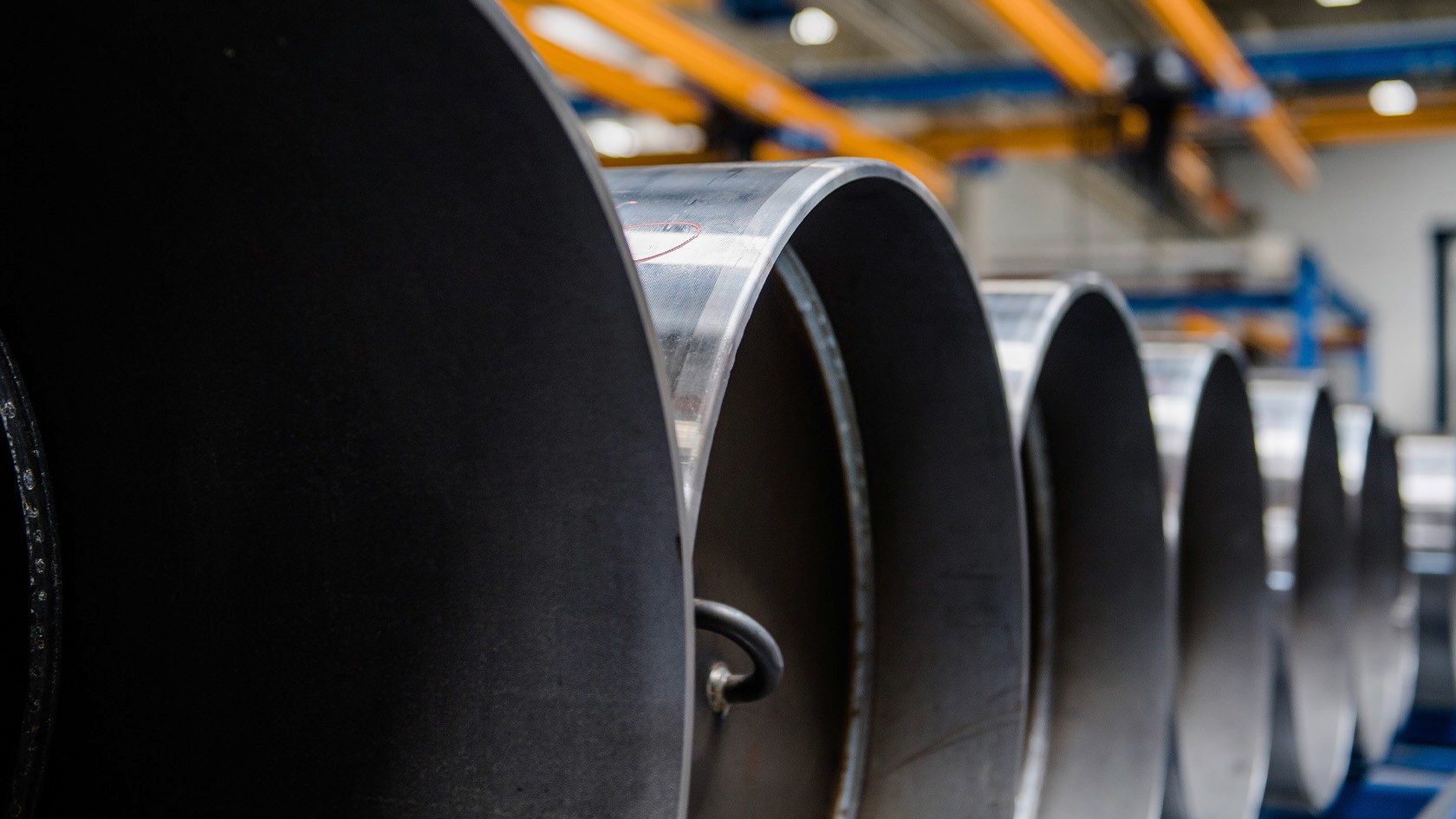
Several Hamm drums are arranged in a row

The Hamm drum factory

Well over 20,000 drums per year. Just-in-time production in top quality.

Drums are the heart of every roller. As a key component of the rollers, a great deal of expertise goes into them. That is why Hamm attaches particular importance to their quality and manufactures all drums in Tirschenreuth in its own state-of-the-art drum factory. In-house production offers maximum flexibility and enables Hamm to maintain the highest quality standards.

Just-in-time production at the main plant in Tirschenreuth

The main plant in Tirschenreuth can produce up to 20,000 rollers per year. Since tandem rollers are equipped with two drums, Hamm requires considerably more than 20,000 drums per year. They are produced just-in-time in a drum plant with an area of over 11,000 m². Thanks to this and short scheduling times, Hamm can respond very flexibly and quickly to market demands.

Tolles Produkt

Up to 120 employees work in multiple shifts at the drum plant. They turn over considerable volumes of material. Among other things, between 12,000 and 15,000 t steel is processed each year. With all components inside, fully assembled drums weigh between 1 and 8 t.

The drum – the heart of the machine.

The production process

The entire manufacturing process – from blasting the sheet metal to painting the fully assembled drum – takes between 9 and 24 hours, depending on the size and type of the drum. A particularly large number of steps are involved in the production of oscillation, VIO, padfoot, and VC crusher drums.

Right from the start, the components that make up the drum are assigned to a specific customer order.

Rust and scale are removed from the panels in a blasting plant.

Step 1: Manufacture of the roller shell

Two to three days before the final assembly of the corresponding machine begins, the production of the drum shell from a flat steel panel starts. The extremely wear-resistant sheets are up to 2.30 m wide, can be 45 mm thick, and weigh up to 4 t. First of all, rust and scale is removed in a blasting plant. In the process, the blasting material is collected and reused.

An employee monitors a panel in the circular-bending machine

Step 2: Circular bending

In the next step, the panels are cold-formed almost completely automatically in one of the four hydraulically operated circular-bending machines. With pressures of up to 280 bar, cylindrical blanks are produced from flat panels in a very short time. Maximum precision is required here; perfect roundness and a correct gap dimension are important. Both are of paramount importance for quality and durability.

Step 3: Longitudinal seam welding

The drum shell is then semi-automatically welded along a longitudinal seam in one of three specialized machines using the submerged arc welding process, which helps reduce welding emissions. Depending on the material thickness, up to eight welding cycles in the computer-controlled process may be necessary to complete the weld.

Up to eight working gears may be required until the weld seam is complete.

Step 4: Pinning and welding of the blanks

The installation of the steel plates – also called circular blanks – then begins. These are welded to the drum shell at precisely specified positions by high-tech robots. The robots use sensors to determine the gap between the workpiece and the electrode with extreme precision and autonomously correct the electrode’s position in the event of deviations. This results in weld seams with perfect strength and position, which subsequently withstand the high loads.

All padfoot drums get their ”feet" at this stage in the process. After attachment by hand, the individual padfoot pads are finally welded to the shell in a 7-axiswelding robot.

Step 5: Storage and cooling of the drums

Before the next machining step, all drums are stored for a certain time. In the process, they relieve the stresses that inevitably arise during the upstream welding processes. The mechanical processing only follows once they have cooled down and are stress-free.

Step 6: Milling the longitudinal joint

In mechanical processing, a distinction is made between drums for earthworks or asphalt construction. In the case of drums for earthworks, a special longitudinal milling machine removes the part of the weld seam that protrudes on the outside.

Tolles Produkt

Step 7: CNC machining at Europe’s most modern machining center

Then it's off to the state-of-the-art CNC machining center built especially for Hamm. It is not only unique, but also the most modern of its kind in Europe. Depending on the drum type, up to 220 bores are created and threads cut in 40 to 100 machining steps. Several holes are bored as high-precision seats accurate to hundredths of a millimeter. In addition, up to 10 plane surfaces are milled to absorb the vibration or oscillation units. This is necessary to ensure that the axles for the vibration and oscillation drives subsequently fit perfectly.

Step 8: Further turning of the drum

The drums for the asphalt construction are further turned in their entirety. This guarantees a perfect surface and thus high surface quality when compacting asphalt.

Tolles Produkt

Step 9: Pre-assembly

In the prefabrication stage, the travel drives, vibration drives, and oscillation drives are assembled into complete subassemblies. The employees then install these in the drums. This means that Hamm ensures that the quality of the mechanically highly stressed assemblies can be monitored down to the smallest component, and maintained at the highest level.

An employee stands at the drum rotating device

Drum rotating device

Using a special drum rotating device, employees lift the shafts with the eccentric masses into the drum and install the drives.

Step 10: Cleaning and coating

Last but not least, the drums pass through the modern paint shop. On a 40-meter cleaning and coating line, the drums are washed, painted in a single-coat process, and dried.

Step 11: Final assembly

From the paint shop, the drums are sent to the final assembly. The mounting brackets and, if required, hydraulic hoses are installed. They are then ready for installation in the rollers and leave the drum plant for the assembly hall for final assembly.

View of multiple drums