
Building material recycling as the key to the circular economy
Mobile processing makes recycled building materials economically viable
Göppingen, 23 November 2026 – The construction industry faces the challenge of reconciling increasing material requirements with the goals of a circular economy. Building material recycling plays a key role in this, as it enables CO₂ emissions to be reduced. With its mobile crushing and screening plants, Kleemann makes a decisive contribution to the economical processing of high-quality recycled building materials.
Basics of recycling
Downcycling, recycling, and upcycling showcase the quality of the recovered material. Downcycling describes the reuse of lower-value materials, such as when high-quality demolished concrete is used solely as filler material. Recycling, on the other hand, aims to recover equivalent building materials that have similar properties to primary materials. With upcycling, targeted processing and innovative methods can even increase the value of the material compared to before. “The general rule is: the greater the effort involved in preparing the material by crushing, screening, sifting, or washing, the higher the quality of the resulting recycled construction materials,” explains Laurin Winter, Product Manager, impact crushers at Kleemann. Modern technologies from Kleemann enable precise separation and processing, resulting in high-quality final products that can often be reused in infrastructure construction.
From waste material to resources
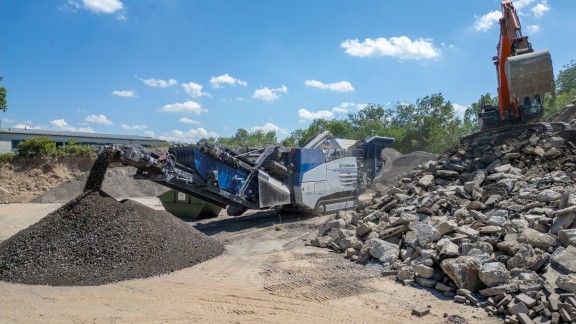
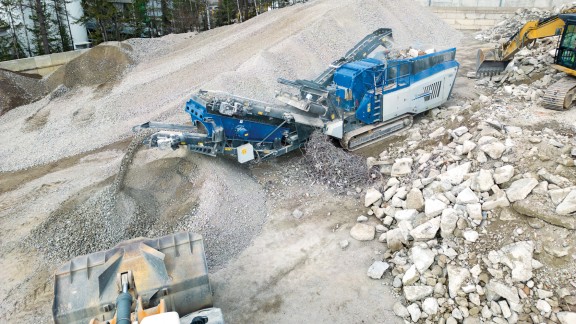
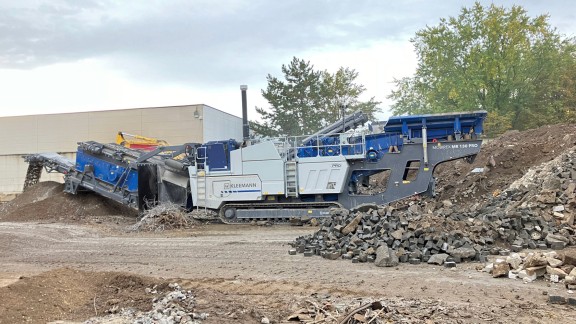
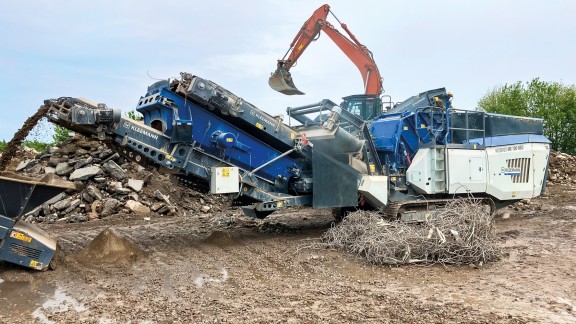
Mixed rubble, consisting of concrete, masonry, asphalt and other mineral components, accounts for the largest share of construction waste in Germany. “Our MOBIREX MR 130 PRO impact crusher is a perfect example of how efficient mixed rubble recycling works: The crusher combines high crushing capacity with energy-efficient drive technology and integrated dust and noise protection. In addition, there are special options geared towards recycling,” says Laurin Winter. The crushing plant can be equipped, for example, with a magnet for iron removal, a secondary screening unit for the classification of two final products, and wind sifting for a clean final product. The result is high-quality RC building materials which, depending on their classification, are suitable for road subgrades, utility trench construction, and even concrete mixes. For the carbon footprint of construction sites, this represents an enormous contribution to resource conservation and a reduction in the number of transport routes.
Old road surfaces given a new life:
Several products from Wirtgen Group are used directly in the field of asphalt recycling. Milling off old road surfaces, crushing them, screening them and using them as recycled chippings or granulate in the mixing process – this is where Kleemann crushing plants work together with Wirtgen milling machines and Benninghoven or Ciber asphalt mixing plants in a single production system. The precise grain processing means that up to 100% of the processed material can be reused.
From removal to recycling: Asphalt recycling in the loop
First screen, then crush: Suitable prescreening reduces the mass to be crushed, lowers wear and energy consumption in the crusher, and simultaneously keeps the content of fines lower. This is the basis for higher RAP addition rates and constant recipes. A Kleemann plant train, for example, demonstrates these advantages and is part of a continuous recycling loop: This begins with the selective milling of the surface course, binder course and base layer using milling machines from Wirtgen. In many cases, more than 60% of the milled material can be reused directly. Separate extraction of the asphalt layers significantly improves the quality of the recycled material. After screening and crushing with the Kleemann plants, the processed material is reused in asphalt mixing plants. Machines from Vögele and Hamm close the circle with installation and compaction. This results in a process that is effective at every stage – from removal and processing, right through to reuse.
Further information on asphalt recycling can be found on the following websites, amongst others:
Impressive in asphalt recycling: Kleemann plant train
Scalping screen in asphalt processing: Scalping screen in asphalt processing

Public Relations
Reinhard-Wirtgen-Straße 2
53578 Windhagen
Germany

Mobile impact crusher
| Drive concept | D-DRIVE (Diesel-direct) |
| Max. feed size | 880 mm x 550 mm x 330 mm |
| Feed capacity up to approx. | 350 t/h |

Mobile impact crusher
| Drive concept | D-DRIVE (Diesel-direct) |
| Max. feed size | 1,040 mm x 650 mm x 390 mm |
| Feed capacity up to approx. | 450 t/h |

Mobile impact crusher
| Drive concept | D-DRIVE (Diesel-direct) |
| Max. feed size | 500 mm x 800 mm x 300 mm |
| Feed capacity up to approx. | 250 t/h |

Mobile impact crusher
| Drive concept | E-DRIVE (Diesel-electric) |
| Max. feed size | 500 mm x 800 mm x 300 mm |
| Feed capacity up to approx. | 250 t/h |