How soil stabilisation works
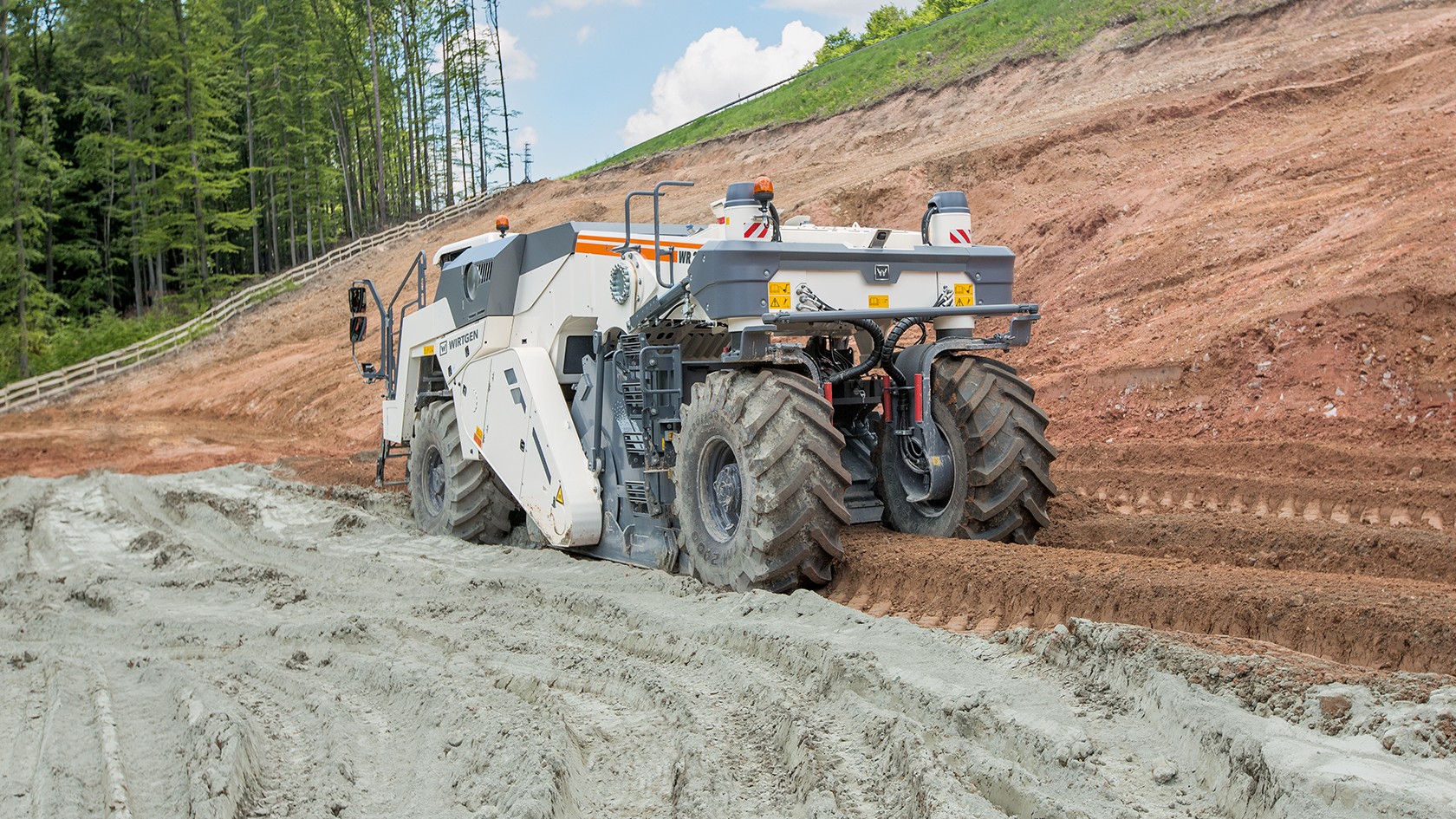

In contrast to complete soil replacement, soil stabilisation can minimise transport logistics and conserve materials. When being used as a soil stabiliser, the WR uses its powerful milling and mixing rotor to mix pre-spread binding agents such as lime or cement into the existing, insufficiently stable soil to working depths of up to 560 mm and convert it into a high-quality construction material in-situ. The resulting homogeneous mixture of soil and binding agent offers outstanding tensile, compressive, and shear strength, long-term resistance to water and fros and volume stability. Typical applications include the construction of paths, roads, highways, routes, parks and sports grounds, industrial estates, industrial plants, airfields, dams, backfilling, and landfill sites.
In the homogenisation process, the WR’s powerful milling and mixing rotor granulates and scarifies the native soil without the addition of binding agents. While a Grader profiles the resulting homogenised soil mixture, various HAMM rollers follow on behind and compact it.
In the soil stabilisation process, an all-wheel-drive Streumaster spreader pre-spreads the binding agent. Behind the binding agent spreader, the powerful milling and mixing rotor of the WR homogeneously mixes the existing soil with the pre-spread binding agent. While a Grader profiles the processed soil mixture, various HAMM rollers follow on behind and compact it.
To produce a new, cement-treated base layer, a Streumaster towed spreader deposits cement, followed by a water tanker. The WR’s powerful milling and mixing rotor homogeneously mixes the material and the pre-spread cement. Water is simultaneously injected into the mixing chamber via an injection bar. While a John Deere Grader profiles the processed base layer material, various HAMM rollers follow on behind and compact it.
The WIRTGEN WR series features a wide range of different models to meet the needs of all soil stabilisation and cold recycling applications.
Learn more about cold recycling


