Technology Concrete paving

For extremely hard-wearing motorways or runways and the production of monolithic concrete profiles, we offer sophisticated processes that make construction easier for you. Leverage our wide range of machines for maximum precision in concrete paving.
Discover the operating principle and technical components of concrete paving. Become familiar with the inset and offset methods and learn more about our standard and special applications.
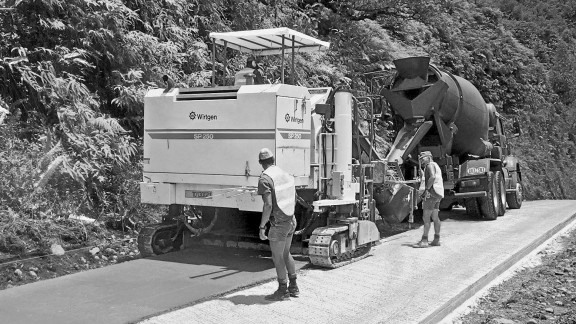
In offset applications, a concrete mixer transfers the concrete to the receiving hopper. The material is transported into the slipform via a belt conveyor or auger conveyor with wide swing angles. Depending on the machine model, the belt conveyor is available in various lengths and in a folding version. The auger conveyor is also available in different variants. Whether belt conveyor or auger conveyor: All settings such as transport speed, slope angle or positioning can be made at the push of a button. An additional transverse charging auger offers many advantages. For example, the concrete mixer can travel in front of the slipform paver and not need to be off to the side, thereby eliminating the need to close another lane. Even though a larger quantity of concrete is required as a buffer, the transverse spreading auger is the ideal solution – as, for example, in tight bends where the concrete mixer is unable to constantly supply concrete to the paver.
In inset paving applications, the concrete is either deposited right in front of the slipform paver or is fed in front of the machine from the side via a belt conveyor or a placer/spreader. In the next step, the concrete is distributed evenly across the full paving width by a spreading auger or spreading plough. Built-in electrical or hydraulic vibrators ensure homogeneous compaction of the concrete. The inset mould forms the concrete surface to the specified thickness and width while the slipform paver travels forward. In addition, a dowel bar inserter can be added which inserts the dowel bars into the concrete as specified parallel to the paver’s direction of travel. Central tie bars or side tie bars can be inserted perpendicular to the road surface. The oscillating beam scrapes the surface across the roadway. The ‘grinding movement’ produces a small concrete roll in front of the beam which adds to the high quality of the concrete surface. Afterwards, the paved concrete surface can be smoothed with a super smoother.
Flexible concrete paving
The innovative system for extending the working width enables quick and convenient reconfiguration of the slab paving mould on the spot. This results in short reconfiguration times and maximum machine utilisation rates with the usual high paving quality.
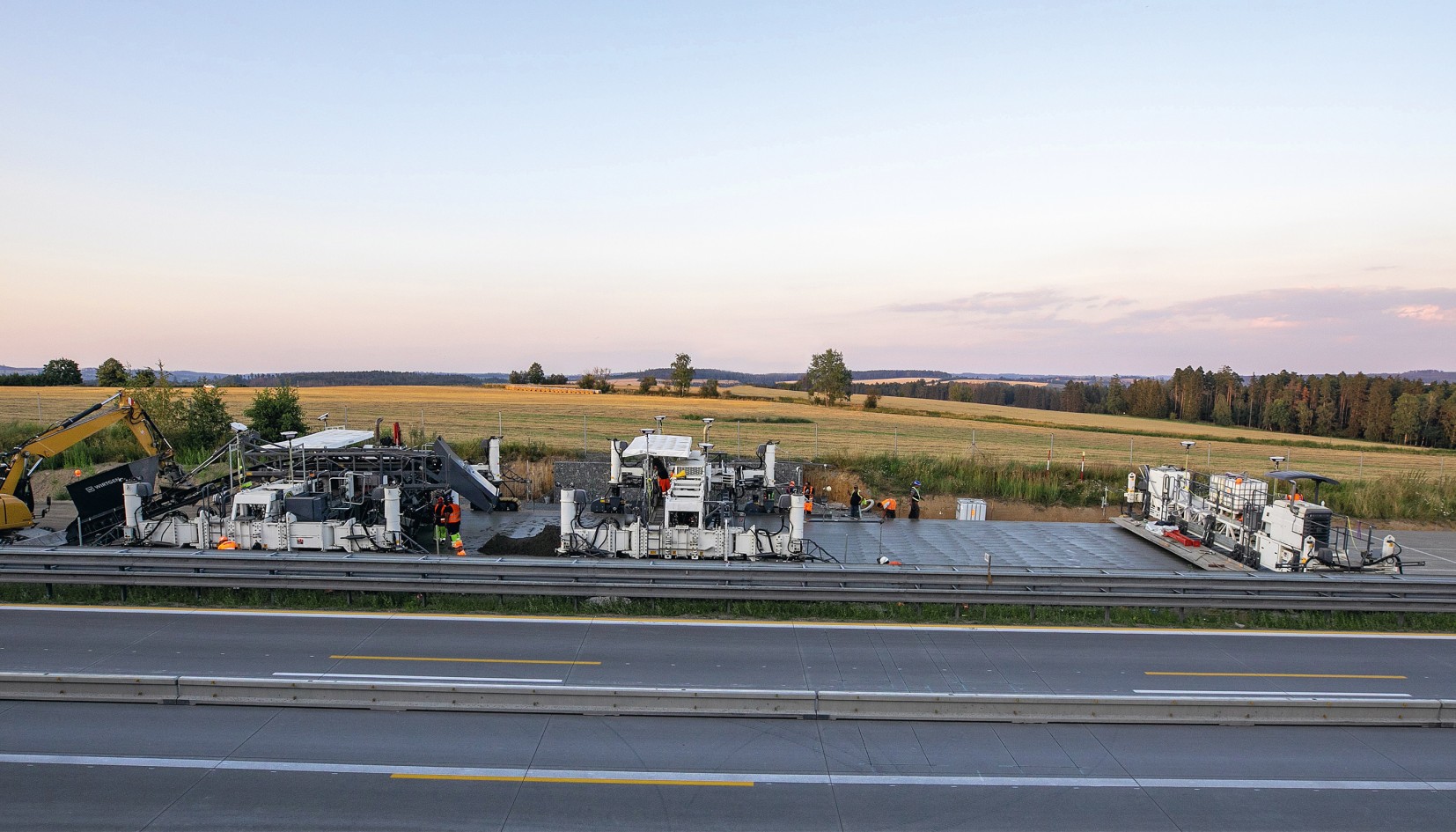
As a rule, a placer/spreader WPS 62(i) is used in combination with a slipform paver and a texture curing machine. While trucks or semi-trailer tippers successively offload concrete into the belt conveyor unit’s large receiving hopper, the belt conveyor guides the material received to the middle of the roadway. The placer/spreader WPS 62(i) uses a spreading auger to spread the placed concrete and paves it uncompacted with a narrower width and greater thickness than the following slipform paver. Finally, the paver paves the pre-spread concrete with the required width and thickness together with the pre-laid reinforcement. To complete the process, the texture curing machine produces a defined surface structure and sprays an evaporation protection film onto the freshly-paved concrete surface.