How soil stabilisation works
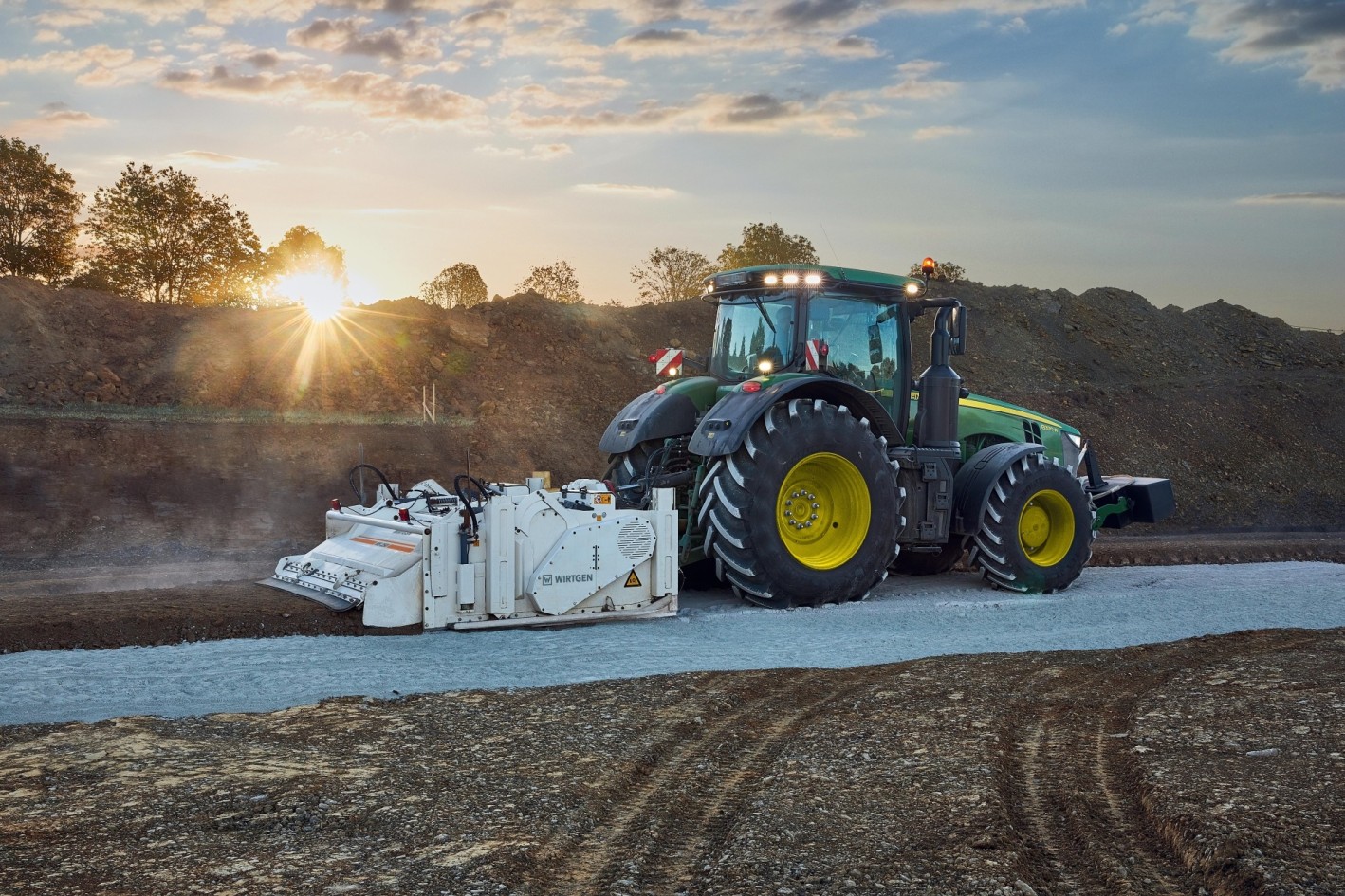

Whether heavy, coarse-grained or sandy soils: a tractor-towed stabiliser can be relied on to reliably transform the sub-base material into soil that is ideal for subsequent paving and compaction. Mixed granulate that is too coarse is crushed by the milling and mixing rotor in the mixing chamber. Soft soil is covered with lime, e.g. by a spreader truck, before processing. During the subsequent, homogeneous mixing process using the milling and mixing rotor, the lime removes the moisture from the soil. Soil improvement proves its worth in earthworks, e.g. for the construction of dams, embankments, backfilling or construction site access roads. Soil improvement has also proven to be highly effective on landfill sites with clayey subsoils. The soil treated with suitable binding agents is practically impervious to moisture and offers ideal preconditions for further compaction.
The recipe for increasing long-term stability in the face of traffic and weather conditions is to strengthen the soil by adding binding agents such as cement. The cement is pre-spread using a spreader truck, for example, and then carefully mixed in by the milling and mixing rotor. The result of soil consolidation is a rigid surface with a permanently high bearing capacity as well as excellent frost resistance. Soil consolidation guarantees a high degree of permanent volume stability. Sample extraction and on-site analyses confirm the defined objectives. The processed areas are ideally suited for the construction of car parks, roads, sports grounds, railway track beds, port facilities, airports, and industrial facilities.


